
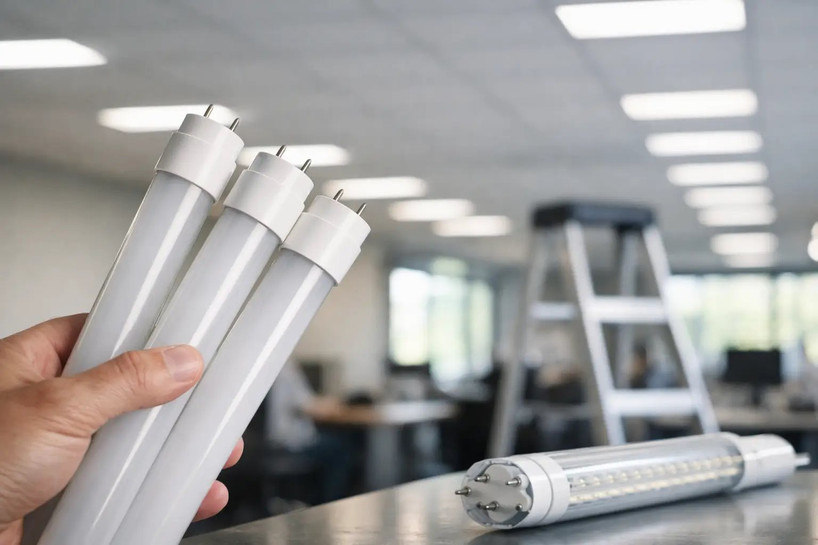
A fluorescent troffer can look like a simple maintenance item until the replacement lamps arrive with the wrong pins, the existing ballasts are failing, or half the ceiling has noticeably different light output. Selecting replacement LED tube lamps correctly prevents those return visits. For offices, warehouses, retail floors, schools, garages, and back-of-house areas, the right tube retrofit can reduce energy use and maintenance while keeping the existing fixture layout in service.
The first purchase decision is not wattage. It is compatibility. Confirm the tube size, length, base, ballast condition, wiring method, and required light level before ordering project quantities. A low-cost lamp that does not match the fixture or installation method is not a low-cost solution.
Start With the Existing Fluorescent Fixture
Most commercial linear fluorescent fixtures use T8 lamps, generally 4-foot tubes with a G13 medium bi-pin base. T5 lamps use a smaller tube diameter and commonly use a G5 mini bi-pin base. They are not interchangeable, even when their overall lengths appear similar. T12 systems may also be present in older buildings and should be evaluated carefully, especially where original ballasts and tombstones are near the end of life.
Measure the installed lamp and read its markings before placing an order. A nominal 4-foot fluorescent lamp does not always have the same physical length as every LED alternative. Check the fixture label, lamp base, and available clearance around reflectors, diffusers, and occupancy sensors.
It also pays to inspect more than one fixture. A facility may have received partial upgrades over time, leaving a mix of electronic-ballast T8 troffers, older magnetic-ballast fixtures, and direct-wire LED tubes in the same building. Treating every ceiling fixture as identical can create an avoidable compatibility problem.
Choose the Right Replacement LED Tube Lamp Type
LED tube lamps are defined largely by how they receive power. The terms Type A, Type B, Type A/B, and Type C should be part of every commercial buyer's specification review.
- Type A LED tubes operate with a compatible existing fluorescent ballast. They are often the fastest retrofit option because the fixture wiring stays in place. Ballast compatibility must be verified by ballast model, not assumed based on fixture age or lamp type.
- Type B LED tubes bypass the fluorescent ballast and connect directly to line voltage. This removes the ballast as a future maintenance component, but requires fixture rewiring by a qualified installer.
- Type A/B LED tubes can operate on a compatible ballast initially or be converted to direct-wire operation later. They provide useful flexibility for phased upgrades or facilities with mixed ballast conditions.
- Type C LED tubes use an external LED driver designed for the lamp system. They are less common for straightforward replacement work but can suit controlled lighting systems and larger specification-driven projects.
A Type A lamp can be a practical choice when the existing electronic ballasts are relatively new, compatible, and performing reliably. The trade-off is simple: the ballast remains a potential failure point. When it fails, the LED tube may still be good, but the fixture goes dark until the ballast is replaced or the fixture is rewired.
Type B direct-wire lamps eliminate that issue. For facilities planning to keep fluorescent housings in operation for years, direct-wire conversion often provides a cleaner long-term maintenance path. It does require more upfront labor and proper fixture labeling after conversion. A direct-wire lamp should never be installed into an unmodified ballast-powered fixture.
Verify Single-Ended or Double-Ended Power
Direct-wire replacement LED tube lamps are available in single-ended and double-ended configurations. This distinction is critical because it determines how line and neutral conductors connect to the lamp holders.
Single-ended tubes receive line and neutral at the same end of the lamp. They commonly require non-shunted lamp holders because the two contacts at that end must remain electrically separate. Double-ended tubes receive line at one end and neutral at the other. Their wiring arrangement may work with shunted or non-shunted lamp holders depending on the product instructions and fixture configuration.
Do not guess whether a tombstone is shunted. With power disconnected and verified off, an installer can inspect or test the lamp holder. A shunted holder has internally connected contacts; a non-shunted holder has separate contacts. Replacement lamp instructions control the wiring method, and the installation must follow applicable electrical code requirements.
For a multi-fixture project, standardize on one approved wiring approach wherever possible. That makes future lamp replacement easier for maintenance teams and reduces confusion when fixtures are serviced years later.
Match Light Output, Not Just Fluorescent Wattage
A common mistake is choosing an LED tube based only on the wattage printed on the old fluorescent lamp. Fluorescent wattage does not tell the full story. Compare delivered lumens, beam distribution, diffuser losses, fixture condition, mounting height, and the task being performed below the fixture.
A typical 4-foot LED tube may use substantially less power than a 32-watt fluorescent T8 while producing comparable usable light. But not every lamp is intended for the same application. A lower-lumen tube may work well in a break room, corridor, or storage closet. A warehouse aisle, assembly area, classroom, or retail display zone may need higher output to preserve target foot-candle levels.
Consider the condition of the existing fixture as well. Yellowed lenses, dirty reflectors, and deep parabolic louvers can reduce light reaching the work plane. Installing brighter lamps may help, but fixture cleaning or a full troffer replacement may be the better answer when housings are heavily deteriorated.
Select Color Temperature for the Space
Color temperature should support the application rather than follow a single building-wide preference. Most commercial tube retrofits fall into three common ranges: 3500K for a softer neutral appearance, 4000K for balanced white task lighting, and 5000K for a cooler daylight appearance with stronger visual contrast.
Many offices, schools, healthcare support spaces, and multifamily common areas use 3500K or 4000K. Warehouses, loading areas, mechanical rooms, and retail back rooms often use 4000K or 5000K. Higher color temperatures can make labels, inventory, and equipment details easier to distinguish, but they can feel overly stark in tenant-facing or hospitality-oriented areas.
For a large retrofit, order a small sample quantity first when possible. View the lamps in the actual fixture, with the actual ceiling height and surrounding finishes, before committing to hundreds of units. This is especially useful when replacing a mix of aging fluorescent lamps that have shifted in color over time.
Check Voltage, Enclosed-Fixture Rating, and Operating Conditions
Commercial buildings may use 120-277V branch circuits, while certain industrial facilities use other voltage arrangements. The lamp's input-voltage rating must match the supply voltage and installation method. This is particularly important for Type B direct-wire installations.
Review whether the LED tube is rated for enclosed fixtures if it will operate behind a sealed lens or in a fully enclosed vapor-tight housing. Heat management affects LED life. A tube installed where airflow is limited must be listed for that condition.
Cold environments deserve attention too. Walk-in coolers, refrigerated storage, unconditioned loading areas, and parking structures can expose lamps to low temperatures. LED tubes typically perform better than fluorescent lamps in cold starts, but product operating-temperature ratings still matter. For damp, wet, food-service, or hazardous areas, a standard tube retrofit may not be appropriate at all. The fixture and application may require a purpose-built vapor-tight, NSF-rated, or hazardous-location solution.
Plan the Retrofit Around Maintenance Costs
The lamp price is only one part of the project cost. Ballast replacements, service calls, lift access, disposal of fluorescent lamps, and disruption to occupied spaces all affect the real number. This is why a direct-wire conversion can make sense even if its installation cost is higher on day one.
For smaller properties with limited maintenance staff, a ballast-compatible Type A option may be the quickest route to improved efficiency. For large facilities with repetitive fixtures and scheduled electrical labor available, Type B conversion often creates a more consistent long-term system. It depends on ballast age, access conditions, labor rates, and how long the property will retain the fixtures.
Keep a record of the selected lamp model, color temperature, wiring type, and fixture locations. Maintenance departments should not have to identify a direct-wire configuration by trial and error after a lamp failure. Label converted fixtures clearly and store the approved replacement specification with building maintenance records.
When a Tube Retrofit Is Not the Best Upgrade
Replacement LED tube lamps are effective when the existing fixture housing is sound, the layout still provides acceptable coverage, and a retrofit meets the lighting requirement. They are not automatically the best answer for every site.
If a troffer has damaged lenses, poor reflectors, repeated wiring issues, or inadequate light distribution, a new LED troffer may provide better performance and a cleaner appearance. High ceilings, harsh industrial conditions, exterior canopies, and emergency egress applications also call for purpose-built commercial fixtures rather than a tube lamp placed into an aging fluorescent housing.
For buyers managing multiple locations, standardizing specifications before ordering protects both the budget and the maintenance plan. Last Stop Lighting can help commercial buyers compare replacement lamp options, fixture requirements, and project quantities so the first shipment supports the work instead of creating another round of corrections.
The practical next step is to pull one representative fixture from each area, document its lamp and ballast details, and test the chosen LED tube before releasing the full order. That small field check is often what turns a lamp replacement into a dependable facility upgrade.