
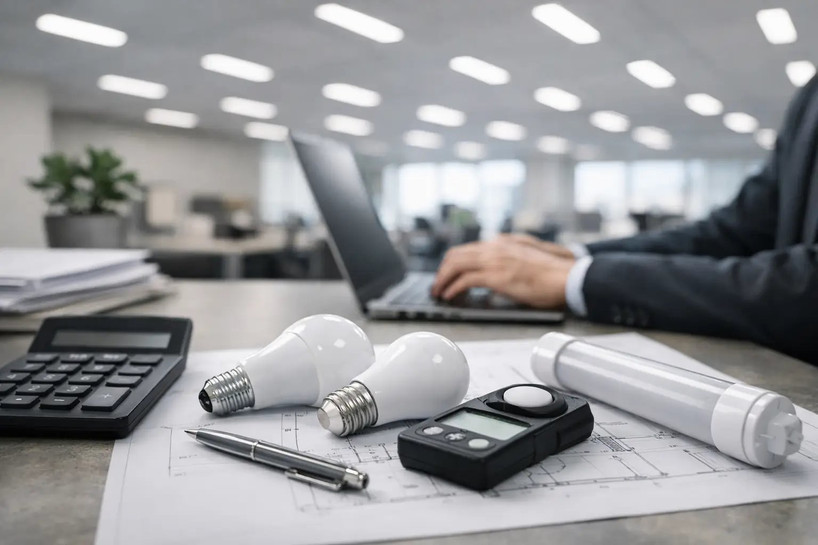
A 200-fixture warehouse retrofit can look profitable on paper and still miss its budget if the operating hours, utility rate, or replacement scope is wrong. A commercial lighting retrofit calculator gives facilities teams and contractors a disciplined way to estimate savings before selecting LED high bays, parking lot lights, wall packs, or interior fixtures. It is a planning tool, not a substitute for a site survey, photometric layout, or code review.
What a Commercial Lighting Retrofit Calculator Should Measure
At minimum, the calculator should compare existing connected load against the proposed LED connected load, then apply real annual operating hours and the facility's electricity cost. The primary output is annual kWh savings. From there, it can estimate annual utility savings, project cost, simple payback, and return on investment.
The basic energy calculation is straightforward:
Annual energy use = Fixture quantity x fixture watts x annual operating hours / 1,000
Run that calculation once for the existing system and once for the proposed system. The difference is the annual kWh reduction. Multiply the result by the blended electricity rate on the utility bill to estimate annual energy-cost savings.
A useful calculator also separates fixture cost from installed cost. Product pricing matters, but a retrofit budget can also include lifts, labor, controls, wiring changes, recycling or disposal, permits, design work, and commissioning. For an occupied facility, work completed after hours can materially change the installed cost.
Inputs That Need to Be Accurate
Fixture wattage is often the cleanest starting point, but it should be verified. A nominal 400-watt metal halide fixture may draw more power at the input because the ballast consumes energy. Fluorescent systems also have ballast losses, and older fixtures may not match the wattage stamped on the lamp.
Use measured input wattage where available. If a field measurement is not practical, use published system wattage from the fixture manufacturer or a reasonable documented assumption. Record the assumption so the savings model can be updated later.
Operating hours deserve the same attention. A warehouse high bay operating two shifts may run 4,000 to 5,000 hours per year. A parking lot fixture controlled by a photocell may run about 4,100 annual hours, while a stockroom light on a wall switch may run far less. Applying 8,760 hours to every fixture makes the return look better, but it rarely reflects actual use.
The electricity rate should include more than a headline energy charge when possible. A blended rate based on total electric cost divided by total kWh is often practical for an initial estimate. Demand charges, time-of-use pricing, and power-factor penalties may require a more detailed utility analysis, especially for large industrial projects.
Build the Retrofit Calculation in the Right Order
Start by organizing the facility into lighting zones. Do not group every existing fixture into one line item just because it has the same wattage. A 250-watt metal halide wall pack at a loading dock and a 250-watt metal halide area light in a parking lot may operate on different schedules and require different replacement optics.
For each zone, document the fixture count, existing fixture type, input watts, annual operating hours, utility rate, and proposed fixture specification. For the proposed LED fixture, capture delivered lumens, wattage, voltage, color temperature, mounting method, distribution pattern, controls, and any required emergency backup or listing.
A simple working table might include these columns:
| Zone | Existing Load | Proposed LED Load | Annual Hours | Fixture Quantity | Notes |
|---|---|---|---|---|---|
| Warehouse aisles | 458W metal halide | 150W LED high bay | 4,500 | 80 | Verify mounting height and aisle optics |
| Loading docks | 175W metal halide | 60W LED wall pack | 3,000 | 18 | Confirm photocell and motion sensor needs |
| Parking area | 320W metal halide | 120W LED area light | 4,100 | 42 | Match pole mount and light distribution |
This structure prevents a common procurement mistake: choosing replacement fixtures by wattage alone. Lower wattage is valuable only if the new fixture delivers the required light levels, uniformity, glare control, and coverage for the application.
Worked Example: Warehouse High Bay Upgrade
Consider 80 warehouse fixtures with an existing measured load of 458 watts each. The proposed LED high bay is 150 watts, and the lighting operates 4,500 hours per year. The facility's blended electric rate is $0.14 per kWh.
The existing annual energy use is 80 x 458 x 4,500 / 1,000, or 164,880 kWh. The proposed LED system uses 80 x 150 x 4,500 / 1,000, or 54,000 kWh. Annual savings equal 110,880 kWh.
At $0.14 per kWh, estimated annual energy savings are $15,523. If fixture, labor, lift, and miscellaneous project costs total $46,000, and a utility incentive reduces the net project cost by $6,000, the net investment is $40,000. Simple payback is $40,000 divided by $15,523, or about 2.6 years.
That is a useful first-pass estimate. It does not include maintenance savings, reduced relamping, avoided ballast replacements, or productivity benefits from improved visibility. Those factors may strengthen the business case, but they should be documented separately rather than used to inflate the energy model.
Account for Controls Without Overstating Savings
Occupancy sensors, daylight harvesting, dimming, scheduling, and bi-level operation can reduce energy use further. They also introduce assumptions. If a sensor is expected to reduce run time by 25%, apply that reduction only to the zones where occupancy patterns and control settings support it.
For example, an LED fixture with a microwave sensor in an intermittently used aisle may provide meaningful savings. The same setting in a busy distribution lane may keep the fixture at high output most of the day. Exterior fixtures with photocells can benefit from scheduled dimming late at night, but security requirements, camera coverage, and tenant expectations need to be considered.
A good practice is to show two scenarios in the commercial lighting retrofit calculator: base LED savings with no control reduction, and a controlled-savings case with clearly stated assumptions. This gives ownership a conservative number for budgeting and a separate upside case for operational planning.
Do Not Let the Calculator Replace Lighting Design
Energy savings do not prove that a replacement fixture is suitable. A 150-watt LED high bay can vary significantly in lumen output, beam angle, optical distribution, and efficacy. The correct selection depends on mounting height, rack layout, task requirements, ceiling reflectance, and target foot-candle levels.
The same rule applies outdoors. Replacing a 400-watt metal halide parking lot fixture with a 150-watt LED area light may cut energy use substantially, but the pole height, mounting arm, Type III, Type IV, or Type V distribution, and site boundary requirements determine whether the result works. Backlight control can matter as much as total lumen output near property lines.
Emergency and exit lighting require another layer of review. Battery backup duration, test requirements, voltage, housing rating, and local approval requirements can affect the replacement choice. Hazardous locations, food-service environments, and wildlife-sensitive areas also call for fixtures with application-specific ratings rather than a general-purpose LED substitute.
Add Cost Items Buyers Commonly Miss
A fixture-only calculation can understate the project budget. Before requesting pricing or placing a purchase order, confirm whether the job requires new mounting brackets, tenons, slip fitters, arms, adapters, photocells, sensors, wire guards, surge protection, or replacement poles. Exterior work may also involve foundation review and pole loading considerations.
Labor costs depend heavily on access. A high bay retrofit requiring a lift over active racking has a different labor profile than a same-height replacement in an open space. If the existing branch circuits, controls, or voltage are incompatible, electrical modifications need to be included before payback is presented to ownership.
Utility rebates can reduce the net cost, but they should not be treated as guaranteed until the program requirements are confirmed. Many programs require pre-approval, qualified product listings, minimum efficacy, controls, specific documentation, or final inspection. Use the expected incentive as a separate line item and identify whether the estimate is pending approval.
Turn the Result Into a Purchase-Ready Scope
Once the savings model supports the project, convert each zone into a clear purchasing scope. Include the exact fixture quantity, wattage, lumen package, voltage, CCT, mounting, optics, control options, and required accessories. This avoids comparing an installed-cost estimate built around one fixture specification against a lower-priced product that lacks the needed mount, sensor, or distribution.
For projects with multiple applications, a centralized supplier such as Last Stop Lighting can help contractors and facilities teams assemble high bays, area lights, wall packs, emergency products, replacement lamps, and installation components in one order. Technical product details should still be checked against the site conditions and project documents before release.
The best retrofit calculation is conservative enough to survive review and specific enough to support a purchase decision. Verify the existing load, use realistic operating hours, select fixtures for the actual application, and keep every cost assumption visible. That approach gives your team a number it can use with confidence when the project moves from spreadsheet to jobsite.