
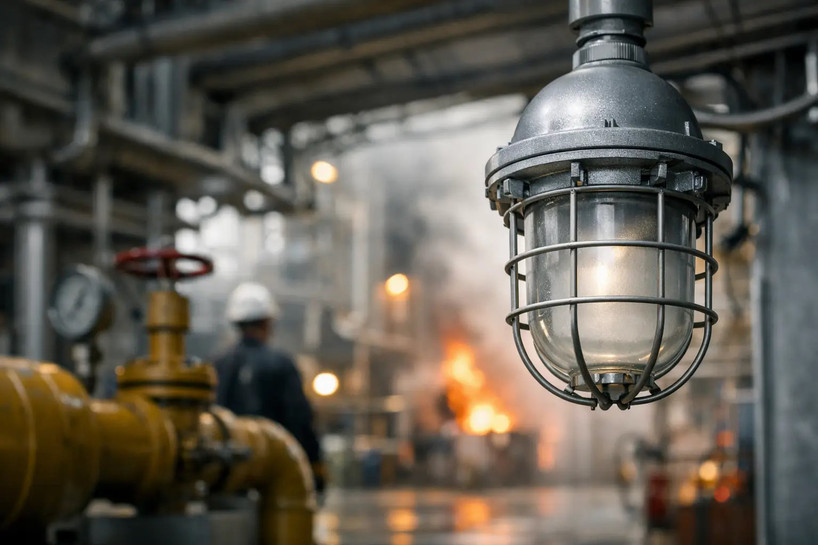
A fixture that looks industrial is not automatically approved for a classified area. In a paint mixing room, grain handling facility, fuel island, wastewater plant, or chemical process area, hazardous fixture selection starts with the location classification - not the lumen package, price, or mounting style. The fixture must be listed and marked for the actual hazard present, then sized to deliver usable light for the work being performed.
A wrong selection can create compliance problems, shorten fixture life, complicate inspections, and introduce an ignition risk. A correct selection gives maintenance teams a dependable LED system that is suited to the environment, the electrical supply, and the facility's operating conditions.
Hazardous Fixture Selection Starts With the Area Classification
The National Electrical Code classifies hazardous locations based on the type of combustible material that may be present and the likelihood that it is present in an ignitable concentration. The facility's drawings, hazardous-area classification study, engineer of record, or authority having jurisdiction should define this before a fixture is ordered.
Class I locations involve flammable gases or vapors. Typical examples include solvent storage, petroleum dispensing, paint spray areas, and some chemical processing spaces. Class II locations involve combustible dust, such as flour, grain, coal, metal dust, plastic dust, and wood dust. Class III addresses ignitable fibers and flyings, often found around textile processing, sawmills, and similar operations.
The Division identifies how often the hazardous material may be present. Division 1 generally covers locations where the hazard exists under normal operating conditions or may frequently exist during maintenance or repair. Division 2 generally covers locations where the material is normally contained but could escape because of an accident, equipment failure, or abnormal operation.
Many facilities also use the Zone system, particularly for Class I gas and vapor applications. Zones 0, 1, and 2 describe the expected presence of ignitable gas or vapor. Do not assume a fixture labeled for a Division application automatically meets a Zone requirement, or the reverse. Review the marking, listing documentation, project specification, and local code requirements with the engineer or AHJ when the designation is not clear.
Read the Fixture Marking, Not Just the Product Name
Terms such as "explosion-proof," "hazardous location," and "vapor-tight" are often used loosely in the field. They do not mean the same thing.
An explosion-proof fixture is designed to contain an internal ignition and prevent it from igniting the surrounding atmosphere when installed as part of a properly rated system. A vapor-tight fixture may resist moisture, dust, and corrosive exposure but may not carry the hazardous-location listing required for a classified space. Likewise, a general-purpose high bay with a tough housing is not a substitute for a listed Class I, Division 2 high bay.
Start with the complete fixture marking. It should identify the approved Class and Division or Zone, as applicable, along with gas group or dust group ratings. The group matters because different gases, vapors, and dusts have different ignition characteristics. A fixture must be approved for the group identified for the location, not simply for the broader Class.
For replacement projects, photograph the existing nameplate, but do not treat it as the only design input. The existing fixture may be underspecified, obsolete, damaged, or installed before a change in process conditions. Confirm the current classification and installation method before ordering a like-for-like replacement.
Temperature Code Is a Primary Safety Specification
Every hazardous-location fixture generates heat. The temperature code, often shown as a T-code, states the maximum surface temperature the equipment can reach under specified conditions. That maximum must remain below the ignition temperature of the gas, vapor, or dust in the area.
A fixture's T-code can change with ambient temperature, wattage setting, voltage, battery backup configuration, and mounting orientation. For example, a selectable-wattage LED fixture may have one temperature code at its lower setting and another at maximum output. Check the product data sheet for the exact configuration being installed.
Do not choose a higher-lumen fixture until its heat rating has been checked. More output can be useful in high-ceiling process areas, but it can also alter operating temperature and require a different approved configuration.
Match the Fixture to the Environment and Task
Classification establishes the minimum safety requirement. It does not finish the lighting design. The selected fixture still needs to withstand the actual environment and put light where crews need it.
In a washdown area, look beyond the hazardous listing to housing material, lens construction, gasket quality, ingress protection, and resistance to cleaning chemicals. In a coastal or corrosive chemical environment, marine-grade finishes, stainless hardware, and corrosion-resistant components may matter as much as wattage. A fixture rated for dust may still fail early if its coating cannot tolerate the surrounding chemicals.
Mounting height and work plane determine whether a high bay, linear fixture, wall pack, flood light, or low-bay configuration is appropriate. A 30-foot ceiling over tanks or conveyors may need a narrow or medium distribution to maintain usable foot-candles below. A service platform may require lower mounting heights, reduced glare, and more controlled distribution. Loading areas and fuel canopies often need vertical illumination as well as horizontal light so personnel can read labels, controls, and safety signage.
Color temperature is an operational choice, not just a visual preference. Many industrial sites use 4000K or 5000K LED fixtures for clearer task visibility. However, glare, reflective stainless surfaces, dark equipment, vapor haze, and employee comfort can affect the best choice. If the application is visually demanding, compare distribution and lens options before defaulting to the highest lumen output.
Confirm Electrical and Installation Details Before Purchase
Hazardous-location ratings depend on the complete installed system. A properly listed fixture can lose its intended protection if it is installed with the wrong hubs, conduit seals, cable glands, junction boxes, or field modifications.
Verify supply voltage first. Commercial hazardous fixtures may be available in 120-277V, 347-480V, 12-24V DC, or other configurations. A universal voltage driver can simplify inventory, but only if it covers the building's actual supply and the rating is valid at that voltage. Check phase, frequency, driver compatibility, and whether the project requires emergency operation.
Mounting also deserves close review. Pendant, ceiling, wall, stanchion, yoke, and conduit-mount options affect aiming, vibration resistance, clearances, and access for service. Heavy industrial equipment, compressors, conveyors, and bridge cranes can introduce vibration that requires a more secure mounting arrangement. A flood fixture aimed at a process line may need a yoke and approved aiming range, while a high bay may require a pendant stem and properly sealed conduit entry.
For emergency paths, identify whether the hazardous area needs a listed emergency fixture, exit sign, battery backup driver, or remote emergency source. Battery backup changes runtime, enclosure size, operating temperature, and maintenance requirements. Standard emergency lighting equipment should not be assumed acceptable inside a classified location.
Build a Submittal Checklist That Prevents Rework
Before releasing a purchase order, collect the information that proves the fixture matches the application. For multi-fixture projects, make this part of the submittal review rather than leaving it to field installation.
- Area classification: Class, Division or Zone, and applicable group designation.
- Required temperature code and maximum ambient temperature.
- Electrical data: voltage, mounting method, conduit entry, controls, and emergency requirements.
- Environmental exposure: dust, moisture, washdown, corrosion, vibration, and impact risk.
- Lighting target: mounting height, required light levels, distribution, glare control, and fixture spacing.
This list also helps purchasing teams compare fixtures fairly. Two products may both be described as hazardous-location LED high bays, yet differ substantially in group approval, T-code, ambient rating, optics, driver options, and warranty coverage. The lower initial price is not the lower project cost if it triggers a rejected submittal, a field change, or premature replacement.
Use Controls Carefully in Classified Areas
Occupancy sensors, photocells, dimming drivers, and wireless controls can reduce operating costs, but every component must be evaluated for the location. The sensor may need to be integral to the listed fixture, located outside the classified boundary, or installed in an approved enclosure. Do not add a general-purpose sensor, photocell, or dimmer to a hazardous fixture without confirming that the completed assembly remains compliant.
Controls should also match the work pattern. Frequent switching can be useful in intermittently occupied service spaces, while continuous operations may benefit more from scheduled dimming or daylight response. In safety-critical work areas, maintain the required light level during normal operation, startup, and emergency conditions.
Plan for Maintenance Before the Fixture Is Installed
LED hazardous fixtures can reduce relamping work, but they still require inspection and cleaning. Dust accumulation can reduce light output and affect heat dissipation. Chemical residue can attack lenses, gaskets, and finishes. Maintenance teams need safe access to drivers, lenses, mounting hardware, and conduit entries without disturbing seals unnecessarily.
Standardizing on a small number of approved fixture families can simplify spare inventory and future replacements. Document the exact catalog number, voltage, optic, mounting hardware, and installed wattage setting. This is particularly useful when selectable-wattage fixtures are deployed across several areas with different mounting heights.
Last Stop Lighting can help commercial buyers narrow hazardous-location options by application, output, voltage, mounting, and required technical features. Bring the area classification and job specifications to the conversation first. A fixture can only be the right value when its listing, temperature rating, and installed configuration all fit the conditions on site.
Before approving the order, have the qualified designer, electrician, or AHJ confirm the final selection against the classified-area requirements. That final check is usually faster and less expensive than correcting a fixture decision after equipment is already mounted.