
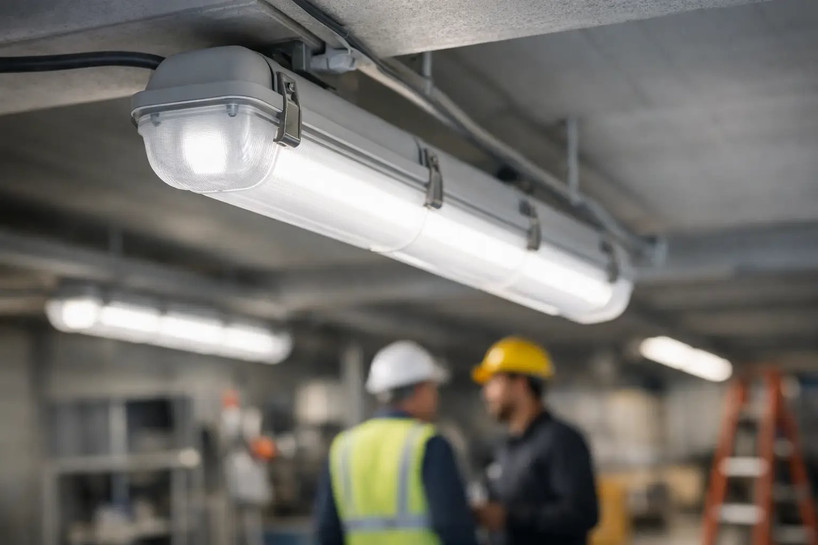
A failed fixture above a wash bay, loading dock, cooler, or parking-garage aisle creates more than a maintenance ticket. It can reduce visibility, interrupt operations, and expose electrical components to moisture and contamination. Vapor-tight LED fixtures are built for these conditions, with a sealed housing, a gasketed lens, and durable construction to keep light where it is needed, even when conventional strip lights or open fixtures are likely to fail.
For contractors and facility buyers, the right choice is not simply the highest-lumen package or the lowest fixture price. The application determines the required wet-location rating, impact resistance, mounting method, distribution, controls, voltage, and material compatibility. A properly specified vapor-tight fixture can reduce relamping, simplify maintenance schedules, and provide reliable general illumination in spaces that are hard on equipment.
What Makes a Fixture Vapor Tight?
A vapor-tight fixture is a linear or enclosed LED luminaire designed to resist moisture, dust, dirt, and non-corrosive contaminants. The term commonly describes the fixture construction: a sealed lens and housing, compression gaskets, protected wiring compartment, and corrosion-resistant hardware. Many models are rated for wet locations and carry an IP rating that identifies their resistance to solid particles and water ingress.
The label matters. An IP65 fixture is dust-tight and protected against water jets, while IP66 provides a higher level of water-jet protection. IP67 can withstand temporary immersion under defined test conditions. Those ratings do not make every fixture suitable for every washdown process, chemical environment, or hazardous location. Buyers should confirm the actual listing, installation instructions, and exposure conditions rather than treating “vapor tight” as a universal approval.
These fixtures are often built with polycarbonate lenses and fiberglass-reinforced polyester, polycarbonate, aluminum, or stainless-steel components. Polycarbonate offers strong impact resistance, but chemical compatibility still needs review where disinfectants, oils, solvents, salt spray, or aggressive cleaning agents are present. A food-processing room, for example, may need a fixture with NSF-related suitability requirements or specific sanitation approvals beyond a standard wet-location rating.
Start With the Environment, Not the Catalog Page
The fastest way to narrow the selection is to identify what the fixture must survive. In a parking garage, moisture, vehicle exhaust, vibration, and occasional impact may be the main concerns. In a car wash or wash bay, direct spray and frequent cleaning become more significant. In a cooler or freezer, low-temperature driver performance and cold-start operation should be confirmed before purchase.
For warehouses, utility corridors, stairwells, and covered loading areas, a vapor-tight fixture may be selected primarily for dust protection and durability. In these locations, a wet-location listing can still be worthwhile because leaks, condensation, and seasonal humidity are difficult to predict. Fixtures installed outdoors under canopies or along exposed walkways need to be evaluated for ambient temperature, wind-driven rain, and mounting stability as well.
Do not substitute a standard vapor-tight fixture for hazardous-location equipment. Where flammable gases, vapors, combustible dust, or ignitable fibers may be present, the fixture must carry the required Class, Division, Zone, group, and temperature-code markings for the site. Explosion-proof and hazardous-location lighting is a separate product category with specific listing requirements. The same distinction applies to emergency egress lighting: a vapor-tight housing does not automatically provide emergency battery backup or code-required emergency illumination.
Match Light Output to the Task
Linear vapor-tight LED fixtures are commonly used as replacements for fluorescent wrap fixtures, industrial strip lights, and older enclosed fluorescent units. Their output can vary widely, so fixture length alone is not a reliable purchasing spec. Compare delivered lumens, wattage, efficacy, lens type, mounting height, and spacing.
A 4-foot unit in a narrow service corridor may provide adequate illumination at a lower output. The same fixture may be underpowered in a wide garage aisle with high ceilings, dark walls, and vehicle traffic. Higher-output 4-foot and 8-foot models are often appropriate for warehouses, loading areas, and industrial work zones, but more output is not always better. Excessive brightness can create glare on glossy floors, equipment displays, or reflective stainless surfaces.
For retrofit projects, start with the existing lighting layout and identify the required foot-candles at the working plane. Then account for light loss from dirt, lens aging, mounting height, and the reflectance of surrounding surfaces. A simple one-for-one replacement may work in a corridor, but large open areas usually benefit from a lighting layout rather than a fixture-count guess.
Color Temperature and Lens Selection
Selectable color temperature fixtures can simplify purchasing when a facility has multiple applications. A 4000K setting is commonly used for neutral, clear illumination in warehouses, garages, utility areas, and back-of-house spaces. A 5000K setting can provide a crisper appearance for loading docks, maintenance areas, and spaces where visual contrast is a priority. Warmer 3500K or 3000K settings may be preferred where occupants spend extended time or where a less stark appearance is required.
Lens construction affects both light quality and durability. A frosted lens softens the appearance of individual LEDs and can reduce glare. A clear prismatic lens may deliver more direct output but can create more visible brightness. In rough environments, lens impact resistance is a practical consideration. Look for an IK rating when carts, forklifts, tools, or incidental contact could damage the fixture.
Specify the Electrical and Control Details
Voltage is one of the first details to verify. Many commercial vapor-tight fixtures use 120-277V drivers, which cover typical 120V, 208V, 240V, and 277V branch circuits. Other models are designed for 347-480V systems. Confirm the building voltage and the fixture’s listed input range before ordering, particularly for industrial facilities and multi-tenant properties where different areas may use different electrical services.
Selectable wattage models can provide useful field flexibility. They allow an installer to set the output level during installation, helping standardize inventory across corridors, garages, storage rooms, and utility spaces. The trade-off is that the selected wattage should be documented on the as-built plan or fixture label. Future maintenance personnel need to know which setting was chosen and why.
Occupancy sensors, daylight sensors, dimming drivers, and microwave motion sensors can reduce operating hours in intermittently occupied areas. Sensors are useful in stairwells, storage spaces, utility rooms, and certain parking areas, but their placement must account for obstructions, vehicle movement, and the required time delay. In cold rooms or spaces with heavy metal racks, sensor performance can be less predictable. For critical areas, verify the control strategy before assuming a built-in sensor will cover the entire zone.
Choose a Mounting Method That Fits the Site
Most vapor-tight fixtures support surface mounting, suspended mounting, or pendant mounting. Surface mounting is common in low-ceiling corridors, coolers, and utility rooms because it keeps the fixture close to the ceiling and limits hardware exposure. Suspended mounting can improve light distribution in higher spaces or below open joists, but it introduces additional considerations for chain, cable, conduit, and vibration.
Confirm whether mounting brackets, V-hooks, suspension kits, wire guards, cord sets, or junction-box accessories are included. Product photos can be misleading when an accessory is sold separately. For retrofit work, measure the existing fixture footprint and verify mounting-point locations before crews arrive on site. This prevents a minor fixture replacement from turning into a ceiling repair or additional conduit job.
Where fixtures are exposed to vibration, use the manufacturer-approved mounting hardware and follow fastening requirements. This is especially relevant near dock doors, mechanical equipment, rail areas, and active vehicle lanes. The electrical connection should maintain the fixture’s environmental integrity, including proper use of rated conduit fittings and seals where required.
Review Service Life and Project Economics
LED vapor-tight fixtures reduce the lamp and ballast maintenance associated with fluorescent systems, but they are still electrical products operating in demanding conditions. Driver quality, thermal management, gasket performance, lens durability, and warranty terms all affect lifecycle value. A low-cost fixture that needs early replacement can cost more than a better-specified unit once lift time, labor, downtime, and disposal are included.
For larger projects, standardizing on a selectable wattage and selectable CCT family can make stocking and future replacements easier. It can also reduce ordering errors when several departments or facilities purchase from the same approved fixture schedule. However, standardization should not override specialized needs such as freezer operation, chemical exposure, hazardous-location listings, or emergency backup.
Before placing an order, build a short fixture schedule with location, mounting height, voltage, output setting, CCT, control requirement, wet-location or IP requirement, and any accessory needs. Last Stop Lighting can help commercial buyers compare fixture specifications and source project quantities without forcing every application into the same product type.
The best vapor-tight installation is usually the one nobody has to think about after commissioning. Specify for the actual environment, document the settings, and choose a fixture that maintenance teams can replace and service with confidence.