
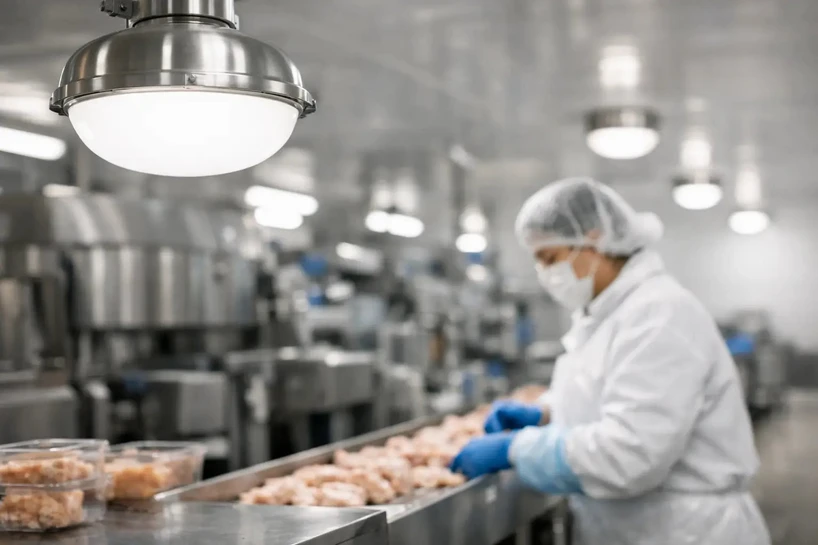
A failed fixture over a packaging line is more than a lighting problem. It can stop production, create a sanitation concern, and force maintenance into an area that should remain controlled. NSF-rated food processing lights are built for this operating reality: frequent cleaning, moisture, temperature changes, strict hygiene practices, and the need for dependable visibility through every shift.
For facilities managers, contractors, and purchasing teams, the right fixture is not simply the brightest industrial LED. The specification must account for where the fixture is installed, what it may be exposed to, how it will be cleaned, and what the sanitation program requires. A fixture that performs well in a dry warehouse may be the wrong choice above a washdown conveyor or inside a refrigerated processing room.
What NSF Rated Means for Food Processing Lighting
In commercial lighting, “NSF rated” is often used as shorthand for a fixture designed and certified for food-processing environments. The exact certification and permitted application matter. Review the manufacturer’s documentation rather than assuming that any sealed, vapor-tight fixture meets the same standard.
NSF requirements generally focus on hygienic construction. Surfaces should be smooth, nonabsorbent, corrosion-resistant, and easy to clean. The fixture should not have exposed areas that trap food residue, moisture, or cleaning chemicals. Lens retention, gasket design, housing material, and the absence of unnecessary seams all affect whether a fixture is suitable for a particular food zone.
This distinction is especially relevant when comparing a general-purpose vapor-tight light with an NSF-certified fixture. Both may carry an IP rating, and both may have a polycarbonate lens, but an IP rating addresses ingress protection. It does not, by itself, confirm that the product is acceptable for a food-processing sanitation environment.
Start With the Processing Zone
The most efficient way to specify food processing lighting is to classify the installation location before selecting wattage, lumens, or mounting. A facility often needs more than one fixture type.
Non-Food Areas
Warehouses, dry storage, offices, shipping rooms, and some mechanical spaces may not require NSF-certified fixtures. Standard high bays, strip fixtures, and commercial vapor tights can be appropriate where the lighting is outside food handling and sanitation exposure. The advantage is broader product selection and, in many cases, a lower fixture cost.
That said, nearby areas can still see dust, humidity, forklift traffic, or occasional washdown. A maintenance-friendly enclosed fixture may still be the better long-term purchase if it reduces lens cleaning and premature replacement.
Splash and Washdown Areas
Areas near open processing, rinsing, filling, or packaging equipment need closer attention. Fixtures may be exposed to water spray, steam, airborne product, or cleaning chemicals. In these locations, look beyond an NSF designation and confirm the enclosure rating, gasketed construction, lens material, corrosion resistance, and mounting method.
A fixture installed directly in the wash path needs a higher level of protection than one mounted over an adjacent aisle. Specify based on actual cleaning practices, not a generic description of the room. Ask whether sanitation crews use low-pressure rinse-down, high-pressure washdown, foam cleaners, or caustic chemicals. Those details affect fixture life.
Refrigerated and Cold Storage Spaces
Cold rooms and freezers introduce a different set of problems. Condensation, thermal cycling, low-temperature driver performance, and frost buildup can affect output and reliability. Select fixtures with an ambient operating range that covers the lowest expected temperature. If the facility frequently cycles between warm and cold conditions, make sure gaskets and lenses are suited to that environment.
Instant-on LED performance is a practical benefit in cold storage, but the driver still needs to be rated for the temperature. Do not assume every LED vapor-tight or high bay is freezer-ready.
Specify the Fixture Construction Before the Light Output
Lumens are critical, but a fixture that cannot tolerate the environment is not a value. Start with the housing, lens, seals, and hardware.
For food and beverage applications, common specification priorities include:
- Corrosion-resistant housings and hardware, particularly in wet areas or facilities using aggressive cleaning chemicals
- A smooth, enclosed exterior with minimal seams, cavities, exposed fasteners, and ledges that can collect contaminants
- Impact-resistant, shatter-resistant lens construction appropriate for the area and facility policy
- A verified ingress protection rating matched to dust, moisture, and washdown exposure
- Gaskets and lens retention systems that remain secure during temperature changes and repeated sanitation cycles
Stainless steel is often preferred in demanding washdown environments, but it is not automatically required everywhere. A high-quality sealed polycarbonate fixture may be a practical choice for moderate moisture areas. The correct material depends on the chemicals used, the frequency of cleaning, and the cost of downtime if a fixture fails.
Also consider the mounting hardware. Pendant-mounted fixtures can simplify service access, but stems, cords, and upper surfaces may create additional cleaning points. Surface mounting can be cleaner in some rooms, provided the fixture and mounting interface do not create a gap that traps debris. Follow the facility’s hygienic design requirements and coordinate with the sanitation team before finalizing the layout.
Match Light Levels and Color to the Task
Food processing work requires accurate visual inspection, safe movement, and consistent performance around equipment. Required foot-candle levels vary by task, room size, ceiling height, product color, and internal quality standards. Inspection stations, trimming lines, labeling areas, and quality-control points usually need more focused illumination than storage or general circulation zones.
LED high bays are often used in larger processing rooms with higher ceilings. Linear enclosed fixtures can work well over conveyors, production lines, and lower-ceiling areas where uniform light is more useful than a concentrated high-bay distribution. For confined equipment areas, low-profile or specialty sealed fixtures may be required to avoid interference with access panels or washdown equipment.
Color temperature affects how workers perceive product, labels, and cleanliness. Neutral to cool white options, commonly in the 4000K to 5000K range, are common for processing environments because they provide a clean, task-oriented appearance. The best choice still depends on the work. A 5000K fixture may support detailed inspection, while 4000K can be a comfortable choice for broad production areas operating long shifts.
Color rendering should also be reviewed where employees must distinguish subtle product color differences, contamination, labels, or packaging marks. Higher CRI can improve visual discrimination, but it may narrow fixture choices or increase cost. Use it where the task justifies it rather than applying the same requirement to every room.
Do Not Overlook Electrical and Maintenance Details
A compliant fixture still has to fit the existing electrical system and maintenance plan. Verify input voltage, including 120-277V or 347-480V requirements, before ordering. Confirm whether dimming is needed, whether controls are compatible with the environment, and whether an emergency lighting function is required by the building design.
Occupancy sensors can reduce energy use in intermittent rooms, but sensor placement requires care. Steam, moving equipment, and line-of-sight obstructions can cause unreliable operation. In critical production areas, a simple switched circuit may be more dependable than an aggressive control strategy.
Maintenance access matters just as much. LED fixtures reduce relamping, but drivers, lenses, and entire fixtures may eventually need service. Choose mounting heights and fixture locations that let maintenance crews work safely without disrupting production more than necessary. Standardizing on a limited number of fixture models can also simplify spare inventory and replacement planning.
Documentation Is Part of the Specification
Before purchasing, collect the product data sheet, certification information, installation instructions, warranty terms, photometric files when layout calculations are needed, and the fixture’s environmental ratings. This paperwork gives the project team a clear basis for approval and helps avoid substitutions that look similar but are not built for the same use.
Be precise in the purchase description. Instead of requesting “washdown lights,” identify the required certification, housing material, voltage, mounting type, lumen range, color temperature, enclosure rating, and any temperature or chemical-resistance requirement. This makes contractor pricing more accurate and reduces delays when the fixture arrives on site.
Last Stop Lighting can help commercial buyers narrow the selection when a project calls for NSF lighting alongside high bays, vapor-tight fixtures, emergency products, or other specialized commercial equipment. The right answer depends on the room, not just the catalog category.
A food processing lighting upgrade should make sanitation easier, improve visibility where it counts, and keep maintenance out of the production schedule. Specify the fixture for the actual conditions on the floor, document the requirements clearly, and the installation will have a much better chance of staying clean, compliant, and in service.