
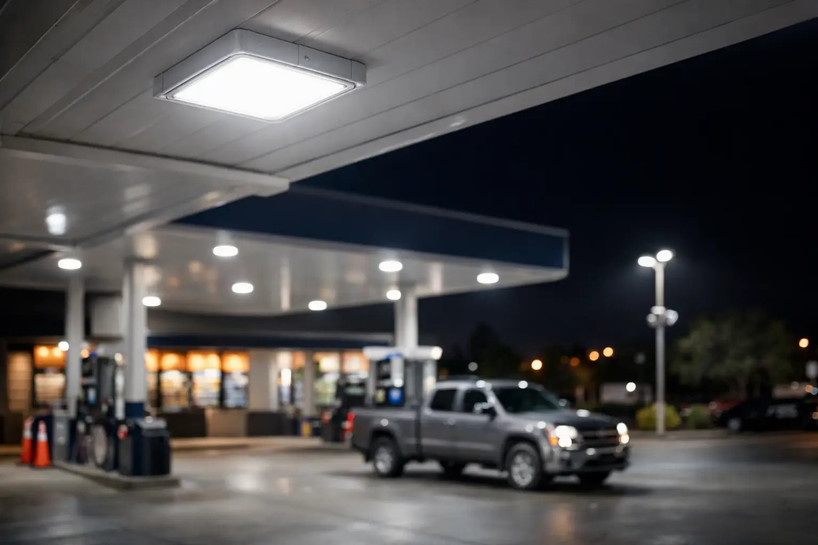
A dark fuel island, drive-through lane, covered entrance, or loading canopy creates more than an appearance problem. It affects driver visibility, pedestrian safety, security-camera performance, and the number of service calls your team receives. LED canopy lights give commercial properties a long-life, high-efficiency way to light these hard-working covered areas without the warm-up time, frequent relamping, or uneven output associated with older HID fixtures.
For contractors and facility buyers, the right fixture is not simply the brightest one on the spec sheet. Mounting height, canopy depth, electrical supply, distribution pattern, controls, and site conditions all affect whether the installation produces useful light where it is needed. A well-selected canopy fixture lowers energy use while maintaining consistent illumination at the pavement, pump island, entry lane, or dock approach.
Where LED Canopy Lights Work Best
Canopy fixtures are designed for overhead installation beneath a covered structure. Their low-profile housings keep the light source protected while directing output downward across the task area. Common commercial applications include gas stations, convenience-store pump canopies, parking-garage entrances, hotel drop-off lanes, bank drive-throughs, restaurant drive-throughs, car washes, loading docks, covered walkways, and building entrances.
The application determines the performance target. A retail entrance needs clear, welcoming light and good facial recognition near doors. A fueling canopy needs broad, even coverage across vehicles, payment terminals, and pedestrian paths. A loading area may require higher output and stronger visibility around trailers, dock doors, and freight activity. Treating all covered spaces as the same application often leads to dark edges, glare, or unnecessary wattage.
Start With Mounting Height and Coverage
Mounting height is the most useful starting point for fixture selection. It influences the lumen package, beam spread, and spacing needed to produce even light at ground level. A canopy mounted at 10 to 12 feet generally requires a different output than one installed 18 to 20 feet above a fuel island or loading lane.
Low canopies can often use lower-wattage fixtures because the light has less distance to travel. Taller canopies usually need more lumens, but increasing wattage alone is not always the answer. The fixture's optical design must spread light evenly across the intended area. A narrow beam can create bright pools directly beneath each fixture and leave the perimeter underlit. An overly wide distribution may waste light outside the canopy footprint or reduce useful footcandles on the ground.
For a replacement project, document the existing fixture locations, canopy dimensions, mounting height, and current lamp or fixture wattage. This information helps establish whether the existing layout is adequate or whether fewer, more efficient LED fixtures can cover the same area. For new construction and larger upgrades, a photometric layout is the better path. It confirms light levels, uniformity, and potential glare before fixtures are ordered.
Compare Lumens, Not Just Wattage
Wattage tells you how much electricity a fixture uses. Lumens tell you how much light it produces. Both matter, but lumen output is the better basis for comparing LED canopy lights across brands and product lines.
A common retrofit mistake is matching the wattage of an existing metal halide fixture to an LED fixture. That approach ignores the higher efficacy and more controlled output of LED technology. A 60-watt LED canopy light may replace a much higher-wattage HID fixture, depending on the original lamp, ballast losses, mounting height, and required light level. The correct replacement should be based on delivered illumination, not a one-for-one wattage comparison.
Selectable-wattage fixtures can simplify purchasing when site conditions vary. A contractor can set the output during installation to fit a lower canopy, a standard pump island, or a higher-traffic entrance without stocking several fixture wattages. The trade-off is that the selected setting must be documented. If a fixture is left at a lower setting than the design requires, the site may look adequately lit at first while still missing its intended light level and uniformity target.
Select Color Temperature for the Site
Most commercial canopy applications use 4000K or 5000K LED lighting. A 4000K fixture provides a neutral white appearance that works well at retail entrances, hospitality properties, and general covered parking. A 5000K fixture produces a cooler, more alert visual environment and is commonly selected for fuel stations, garages, industrial facilities, and security-focused exterior areas.
Neither choice is automatically better. Cooler light can improve the perception of brightness and visual detail, while neutral white often feels less harsh in customer-facing locations. If the canopy connects to wall packs, parking-lot lights, or bollards, matching or closely coordinating color temperature helps the property look intentional after dark.
Color rendering also deserves attention where identification matters. Higher CRI can improve the appearance of signage, vehicle colors, payment screens, and merchandise near a storefront. It may not be the primary purchase factor for every loading canopy, but it can matter at public-facing sites.
Verify Voltage, Mounting, and Physical Fit
Before ordering, verify the available electrical supply. Many commercial LED canopy fixtures operate on a broad 120-277V range, which covers common line-voltage applications. Other projects require 347-480V fixtures, particularly at industrial sites or facilities with higher-voltage service. Do not assume a universal-voltage fixture supports every system voltage.
Mounting details are equally important. Surface-mount canopy lights are common for soffits and solid canopy ceilings. Recessed fixtures require compatible cutout dimensions and adequate space above the mounting surface. Pendant-mounted models can be useful when the fixture needs to hang below a structural element, but they require attention to vibration, clearance, and wiring methods.
Measure the existing opening and review the fixture dimensions before treating a retrofit as a direct swap. A new LED housing may be smaller or larger than the old fixture, which can expose unfinished surfaces, require an adapter plate, or create a weather-sealing issue. At outdoor canopies, the installation must preserve the rating of the assembly and protect wiring connections from moisture.
Use Controls Where They Deliver Real Savings
Canopy lights often operate for long hours, making controls a practical way to reduce consumption without sacrificing safety. Photocells can switch fixtures on at dusk and off at daylight. Occupancy or motion sensors can reduce output during low-traffic periods and return fixtures to full brightness when a vehicle or person enters the area. Some fixtures support dimming or integrated sensor packages, while others need external controls.
Controls should match the use case. A constantly active fuel canopy may benefit most from photocell operation and scheduled dimming rather than aggressive motion-based shutoff. A covered employee entrance or low-traffic garage area may be a better candidate for occupancy sensing. Consider minimum dim levels, sensor coverage, response time, and whether the control arrangement will create sudden changes in light that users find distracting.
For safety-critical locations, avoid control strategies that leave paths, payment areas, or doorways too dark between activations. Savings are valuable, but visibility remains the first requirement.
Look Beyond the Fixture Price
A lower fixture price does not always produce the lowest project cost. Buyers should evaluate rated life, warranty terms, driver quality, surge protection, operating temperature range, and the availability of replacement components. Fixtures in gasoline stations, car washes, coastal areas, or exposed loading canopies may face moisture, vibration, heat, salt air, or chemical exposure that demands a more application-specific product.
IP rating indicates the fixture's resistance to dust and water intrusion. Wet-location suitability is essential where the fixture may be exposed to rain, washdown conditions, or wind-driven moisture. For fueling locations or other regulated environments, confirm whether hazardous-location requirements apply to the precise installation area. A standard canopy fixture is not a substitute for a listed hazardous-location fixture where the code or site classification requires one.
Surge protection also matters on exterior electrical systems. Utility disturbances and switching events can shorten driver life, especially across large sites with exposed circuits. Specifying adequate surge protection can prevent early failures and costly lift-truck service calls.
A Better Purchase Checklist
Before placing an order, confirm the application, mounting height, canopy dimensions, fixture spacing, voltage, mounting method, desired color temperature, lumen target, and control requirements. Review wet-location or hazardous-location needs, then check physical dimensions against the existing opening or mounting surface. For a multi-fixture project, verify that the selected product is available in the required quantity and that all units will use the same settings.
If the project includes parking-lot fixtures, wall packs, or exterior emergency lighting, coordinate the color temperature and operating controls across the site. This avoids a patchwork appearance and makes maintenance easier for the facilities team.
Last Stop Lighting can help commercial buyers compare canopy fixture wattage, voltage, sensor options, and application-specific requirements before a project moves from estimate to installation. The best LED canopy light is the one that gives drivers, customers, and staff dependable visibility every night while keeping operating and maintenance costs under control.