
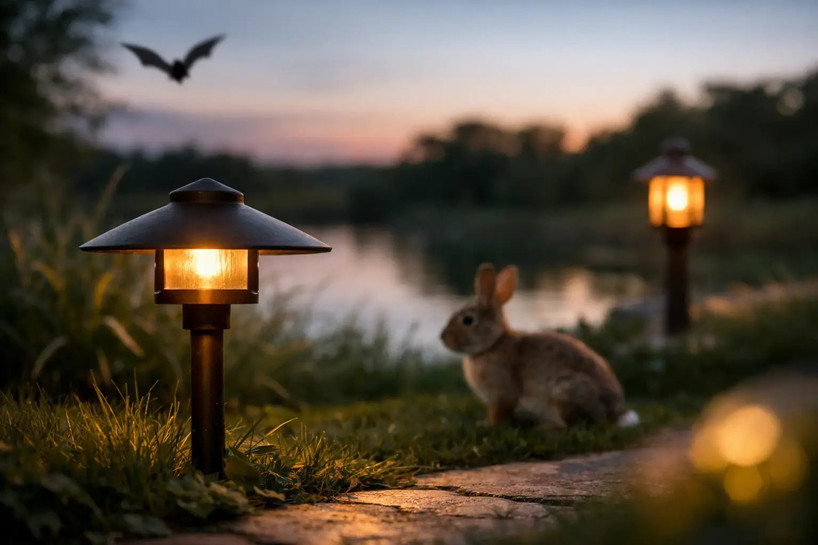
A parking area can be well lit without sending bright, blue-white light across a wetland, tree line, shoreline, or neighboring habitat. Wildlife-friendly outdoor lighting fixtures give commercial properties a practical way to maintain nighttime safety while limiting the light characteristics most likely to disrupt animals after dark.
For contractors, facilities teams, and property owners, the goal is not to make a site dimmer by default. It is to specify the right spectrum, distribution, shielding, mounting location, and controls for the task. A properly selected LED area light, wall pack, bollard, or flood light can reduce spill and glare while still delivering usable illumination where vehicles, pedestrians, loading activity, and security needs require it.
What Makes Outdoor Lighting Wildlife Friendly?
Wildlife-safe lighting is often discussed as though it is one product category. In practice, it is a fixture-and-layout decision. The most effective installations direct light downward, use the lowest practical light level, limit short-wavelength blue output, and operate only when lighting is needed.
Many nocturnal species use natural darkness and changing light conditions to navigate, feed, reproduce, and avoid predators. Blue-rich white light can be especially disruptive because it is highly visible to both people and many animals. Sea turtles are the most familiar example in coastal areas, but birds, insects, bats, amphibians, and other species can also be affected by poorly controlled exterior lighting.
For commercial purchasing, evaluate these four factors together:
- Color temperature and spectrum: Amber and very warm LED options, commonly 2200K or below, reduce blue-rich content compared with typical 4000K or 5000K white lighting. A fixture labeled amber, turtle-friendly, or wildlife-safe should still be reviewed for its actual spectral output and the local standard that applies.
- Optical control: Full cutoff optics, house-side shields, glare shields, and tightly controlled distributions keep light on pavement, doors, pathways, and work surfaces instead of projecting it upward or outward.
- Light level: More lumens are not automatically safer. Overlighting increases glare, trespass, energy use, and biological impact. Design around the required horizontal and vertical illumination at the task area.
- Operating schedule: Dimming, photocells, motion sensors, and time-based controls reduce unnecessary hours of operation. This is often the fastest improvement on sites with limited budgets.
A warm CCT alone does not make a fixture wildlife-friendly. An unshielded 2200K flood light aimed toward water can still create a major problem. Conversely, a fully shielded amber fixture aimed precisely at a pedestrian route may provide a far better outcome.
Match Wildlife Friendly Outdoor Lighting Fixtures to the Application
The fixture type must fit the job. Replacing every exterior luminaire with one style can create poor uniformity, glare at entrances, or insufficient lighting at a loading area. Start by separating the property into task zones and environmentally sensitive zones.
Parking Lots, Drives, and Access Roads
Parking lot and roadway fixtures need controlled forward throw and low glare for drivers. Specify a full-cutoff LED area light with a distribution that matches the pole placement and pavement geometry. Type III, Type IV, and Type V distributions can each be appropriate depending on whether poles sit along an edge, in a median, or within an open lot.
Where a lot borders habitat, select the distribution that stops at the property edge rather than simply increasing pole height or wattage. House-side shielding may be necessary for perimeter poles. Warm or amber lighting can be used near sensitive boundaries, while a separate lighting approach may be needed for high-activity areas farther from habitat. The right answer depends on the required security level, camera performance, local ordinances, and the distance to the protected area.
Building Entries and Walkways
Wall packs and entrance lights are frequent sources of upward light and harsh glare, particularly older HID fixtures with clear refractors. Replace them with full-cutoff LED wall packs that place light below the horizontal plane and use an appropriate lens or shield. For pedestrian entrances, uniform low-level lighting is usually more useful than one high-output fixture that creates bright spots and deep shadows.
Bollards can work well along walkways when their optics are fully shielded and installed at sensible spacing. Avoid decorative bollards or post-top fixtures that emit light above the horizon unless the project specifically requires them and the site is not environmentally sensitive.
Loading Docks, Service Yards, and Perimeters
Docks and service yards require enough illumination for vehicles, workers, doors, and hazards. This is where wildlife objectives must be balanced carefully against OSHA-related work practices, security procedures, and operational schedules. Use task-focused dock lights, controlled wall packs, or flood fixtures with precise aiming instead of broad, continuously operated floods.
A warm-spectrum fixture is useful, but directional control matters just as much. Mount fixtures low enough to aim at the work zone where possible, use visors or shields, and keep beams off adjacent vegetation, drainage corridors, and water. For intermittent activity, occupancy sensors or scheduled dimming can cut nighttime impact without compromising active work.
Coastal and Regulated Areas
Coastal properties may be subject to municipal, county, state, or permit-specific turtle-lighting requirements. These rules can define allowed wavelengths, fixture shielding, mounting heights, visible light limits from the beach, and seasonal operating conditions. Do not assume that a generic amber LED satisfies a local turtle-friendly requirement.
Request the project standard before ordering fixtures. Confirm whether the requirement applies to new construction, replacement fixtures, temporary work lighting, signage, or all exterior illumination visible from the shoreline. Product documentation should support the specification, but site orientation and installation details still determine compliance.
Specifications That Matter Before You Buy
A commercial fixture schedule should identify more than wattage and lumens. For wildlife-conscious projects, include the selected CCT or amber spectral option, distribution type, shielding requirement, mounting height, aiming direction, controls, and voltage. Selectable-wattage and selectable-CCT fixtures can be convenient for general projects, but they require disciplined field setup. If a wildlife plan calls for 2200K, leaving a fixture set to 3000K or 4000K defeats the intent.
Review lumen output in relation to mounting height and spacing. Lowering wattage can reduce environmental impact, but only after confirming uniformity and minimum light levels at walking paths, dock edges, stairs, and other hazards. A photometric layout is especially valuable for parking lots, long pathways, and large campuses because it shows where light actually lands.
Ingress protection and construction also remain standard commercial concerns. Select an outdoor-rated fixture with the appropriate IP rating, surge protection, corrosion resistance, and operating temperature range for the site. Coastal installations may need enhanced corrosion protection, while industrial yards may require fixtures rated for vibration, dust, chemicals, or hazardous locations. Wildlife sensitivity does not reduce the need for a durable, application-specific fixture.
Avoid These Common Specification Mistakes
The most common mistake is treating color temperature as the entire solution. A 2700K fixture can still cause significant trespass if it has an open optic, excessive lumen package, or poor aiming. Another mistake is replacing HID lighting watt-for-watt. LEDs often need substantially less wattage to produce the required usable light, and retaining an oversized lumen package can lead to glare and wasted energy.
Also avoid relying only on motion sensors for critical paths. A sensor can be effective in a seldom-used service yard, but it may be a poor choice at a busy public entrance or for camera coverage that requires consistent light. Consider a dim-to-low setting rather than full off where basic orientation or security lighting must remain available.
Finally, do not install shields as an afterthought. A shield can alter the fixture distribution and create dark areas if it was not part of the original layout. Specify the optical accessories with the fixture and verify their effect before installation.
Build a Better Exterior Lighting Plan
Begin with a nighttime site review. Identify where light is needed for a defined task, where existing light crosses the property line, and where sensitive habitat begins. Then establish the lowest practical lumen level and warmest practical spectrum for each zone, while preserving safe access and operational visibility.
For projects that need commercial-grade area lights, wall packs, bollards, dock lighting, or specialized wildlife-safe options, Last Stop Lighting can help buyers narrow the fixture, optical distribution, wattage, and control package before ordering. The right fixture is only part of the solution. Careful placement, aiming, and commissioning are what keep light where people need it and darkness where wildlife depends on it.