
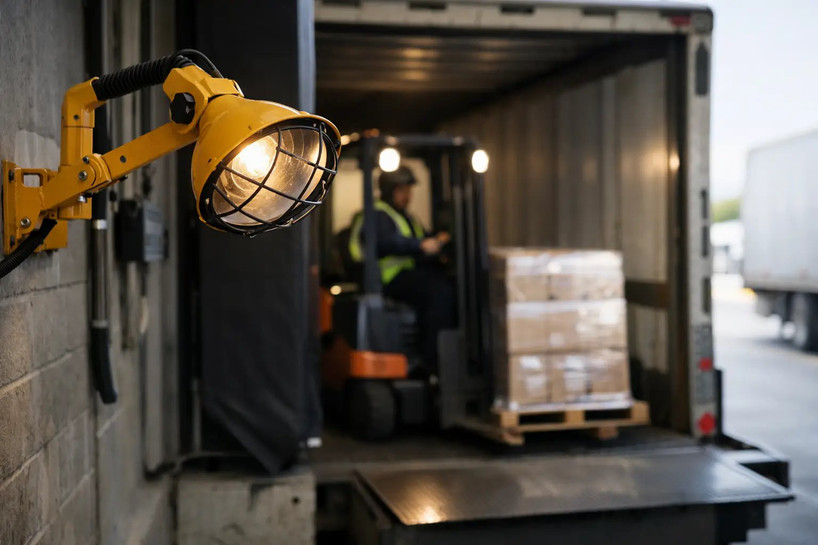
A dark trailer is not a minor inconvenience at a busy dock. It slows unloading, hides damaged pallets and floor hazards, and puts forklift operators, drivers, and dock teams at unnecessary risk. The best loading dock lights put usable light exactly where freight moves - inside trailers, around dock doors, and across the approach - without creating glare that works against the people doing the job.
For most commercial facilities, LED dock lighting is the practical starting point. It reduces maintenance, provides instant full output in cold conditions, and stands up better to frequent switching than older metal halide or high-pressure sodium equipment. But “LED” alone is not a specification. Fixture placement, light distribution, mounting hardware, voltage, controls, and environmental rating all determine whether a dock-light upgrade actually improves operations.
What Makes the Best Loading Dock Lights?
The right fixture depends on the part of the dock you need to illuminate. Trailer interiors require a focused, adjustable task light. Dock aprons and building-side traffic areas need broad, controlled exterior coverage. A single fixture type rarely handles both jobs well.
A dependable loading dock lighting plan usually combines interior trailer lighting with fixed exterior fixtures at the dock face, drive lanes, pedestrian routes, and staging areas. This layered approach reduces deep shadows during early-morning receiving, evening shipping, and winter operations when daylight is limited.
Trailer task lighting needs reach and adjustability
For loading and unloading inside trailers, an articulating LED dock light is generally the best fit. These fixtures mount near the dock door and use a swing arm, gooseneck, or adjustable head to direct light into the trailer. The operator can position the beam where work is occurring rather than flooding the dock opening with uncontrolled light.
Look for a fixture with enough arm reach to clear dock seals, bumpers, and door hardware. A durable pivot mechanism matters just as much as output. A dock light may be moved dozens of times per shift, so weak joints, lightweight arms, and poorly protected cords become maintenance problems quickly.
Light output should be selected for the trailer depth, interior finish, and task. A white trailer liner reflects light more effectively than dark or dirty interior surfaces. Higher-output LED dock lights can be appropriate for deep trailers, high-volume operations, or docks handling mixed freight after dark, but excessive output aimed at the wrong angle can produce glare on shrink wrap, metal racking, or forklift windshields.
Exterior dock lighting needs coverage and cutoff
Outside the dock, wall packs, adjustable flood lights, canopy fixtures, and area lights each serve different roles. Wall-mounted LED flood lights can direct light across a dock apron or trailer approach. Full-cutoff wall packs help illuminate the building perimeter while limiting upward spill. Canopy lights work well under covered loading areas where a downward, wide distribution is needed.
The fixture should be selected around the actual geometry of the site. Mounting height, dock-door spacing, overhang depth, truck circulation paths, and neighboring property lines all affect the right beam pattern. A high-output flood light may cover a large approach area, but a fixture with poor shielding can create direct glare for truck drivers backing into position.
For exterior use, prioritize a weather-resistant housing and a wet-location rating appropriate for the installation. Dock areas face rain, dust, vehicle exhaust, vibration, temperature swings, and occasional impacts. Die-cast aluminum housings, sealed LED drivers, impact-resistant lenses, and corrosion-resistant finishes are practical features, not upgrades for appearance.
Key Specifications to Compare Before Buying
Commercial buyers should compare dock lights by application and performance data rather than wattage alone. LED wattage helps estimate energy use, but lumen output, distribution, and control of that output determine whether the light is useful on the floor.
For trailer task lights, start with delivered light at the work area. A fixture that produces strong, concentrated illumination at the trailer floor and pallet height is more effective than one with higher advertised lumens dispersed across the door opening. Adjustable heads allow the dock team to adapt to different trailer lengths and freight configurations.
For fixed exterior fixtures, photometric performance is especially valuable. It shows how light spreads across the apron and identifies potential dark zones between doors or at the back of trailer positions. When a project includes multiple dock doors, consistent fixture spacing and aiming are usually more effective than placing one oversized light over each area.
Color temperature also affects visibility. Many industrial dock applications use 4000K or 5000K LED fixtures. A 4000K light offers a neutral white appearance that works well for general facility operations. A 5000K fixture provides a cooler, crisper appearance that can help with visual detail in active shipping and receiving areas. The best choice depends on adjacent lighting, employee preference, and how the facility manages glare and reflected light.
Voltage compatibility should be confirmed before ordering. Many commercial LED fixtures operate on 120-277V input, while some projects require 347-480V equipment. Do not assume a replacement fixture matches the existing electrical system. Verify branch-circuit voltage, mounting location, wire access, and whether a hardwired fixture, corded dock light, or plug-in configuration is appropriate.
Mounting and Controls Matter at Active Docks
A high-quality fixture can still perform poorly if it is mounted in the wrong place. Trailer lights should be located where operators can move the fixture easily without interfering with dock doors, vehicle restraints, seals, or pedestrian traffic. The head should aim into the trailer rather than toward approaching drivers or workers standing at the dock edge.
Fixed exterior fixtures need mounting locations that account for trailer height and open door positions. A light mounted too low may be blocked by a trailer. One mounted too high may throw light beyond the work zone and create uncomfortable brightness near the building wall. Adjustable knuckle mounts and slipfitter options can simplify aiming when the final beam direction needs field adjustment.
Controls should match the dock schedule. Photocells are useful for exterior fixtures that operate from dusk to dawn. Motion sensors can reduce energy use in lower-traffic areas, though sensor placement must avoid false triggering from truck movement or missed activation where people need immediate light. For occupied loading docks, a combination of scheduled controls and manual override is often more reliable than motion sensing alone.
Trailer task lights are usually best kept simple. A clearly accessible on/off switch and durable operating hardware reduce confusion during busy shifts. If a dock is staffed continuously, the energy savings from complex controls may not justify the added failure points.
Safety, Compliance, and Special Conditions
Dock lighting is part of a larger safety plan, not a replacement for required emergency lighting. Exit signs, emergency egress fixtures, and battery backup units should be specified separately to meet applicable building and life-safety requirements. A standard dock light does not provide emergency illumination unless it is specifically designed and listed for that function.
Facilities handling flammable vapors, chemicals, grain dust, or combustible materials may need hazardous-location lighting. Standard LED dock fixtures are not automatically suitable for classified areas. The required Class, Division, Group, or Zone designation should be confirmed before selecting equipment. This is one area where matching the fixture to the environment is non-negotiable.
Also consider impact exposure. Forklifts, pallet jacks, trailer movement, and freight can damage low-mounted fixtures and exposed cords. Protective guards, strategic mounting, and protected cable routing can extend fixture life and reduce avoidable downtime.
A Practical Fixture Mix for Most Loading Docks
Many facilities get better results by treating the dock as three separate lighting zones: trailer interiors, the dock face and apron, and circulation routes around the building. Articulating LED dock lights serve the trailer zone. Wet-location wall packs, floods, or canopy lights serve the apron. Area lights or pole-mounted fixtures support vehicle and pedestrian movement beyond the immediate loading area.
This approach also makes phased upgrades easier. A facility can first replace failing trailer lights at the busiest doors, then improve exterior coverage where employees report shadows or drivers have difficulty backing in. It avoids spending the entire budget on one fixture category while leaving the rest of the workflow underlit.
When comparing products, prioritize commercial-duty construction, suitable voltage, mounting compatibility, weather protection, and a beam pattern that fits the actual work zone. Last Stop Lighting can help contractors and facility buyers narrow options across dock lights, wall packs, flood lights, canopy fixtures, and related commercial lighting components.
The right dock lighting should make every shift easier to run: drivers can see the approach, crews can inspect freight, forklift operators can work confidently, and maintenance teams are not replacing fixtures after every hard season.