
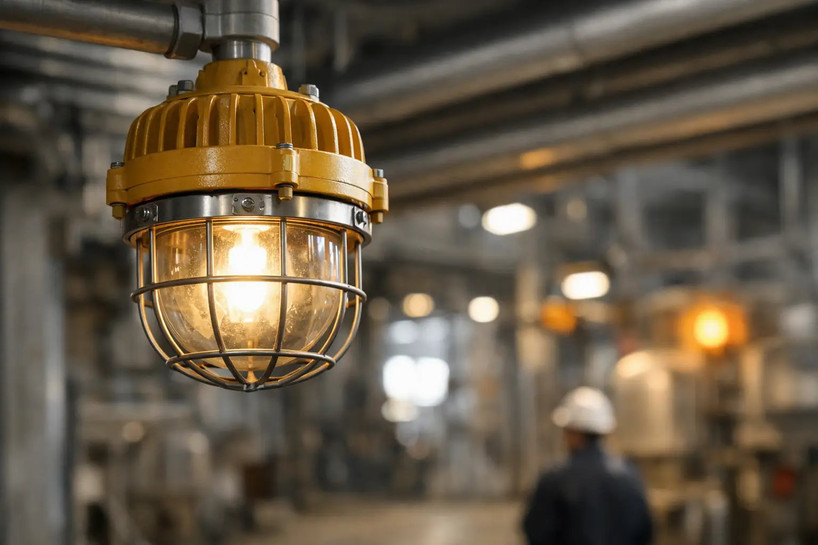
A hazardous-location fixture is not simply a tougher version of a standard LED high bay or flood light. It is part of the facility's ignition-control strategy. This explosion-proof lighting guide explains how commercial buyers can specify lighting that matches the hazardous material, the classified area, and the actual installation conditions without paying for the wrong rating.
The first point matters: “explosion-proof” does not mean a fixture prevents an explosion from occurring. Properly listed equipment is designed to contain an internal ignition and prevent it from igniting the surrounding atmosphere when installed in the location for which it is approved. The fixture's label, application rating, wiring method, and installation quality all matter.
Start With the Hazardous Location Classification
Do not select a fixture based on the words “explosion proof” alone. Begin with the location classification shown on project documents or supplied by the authority having jurisdiction, facility engineer, or safety professional. Under the National Electrical Code, hazardous locations are commonly identified by Class, Division or Zone, Group, and temperature code.
Class identifies the broad type of hazard. Class I locations involve flammable gases, vapors, or liquids, such as fuel-handling areas, paint spray operations, chemical processing rooms, and some refinery applications. Class II locations involve combustible dust, including grain, flour, coal, metal, and certain plastic dusts. Class III locations involve easily ignitable fibers and flyings, often associated with textile or woodworking operations.
Division and Zone describe the likelihood that the hazardous material will be present. Division 1 generally means the hazard exists during normal operations or frequently enough to require the highest level of protection. Division 2 generally describes an area where the hazard is normally contained but could be present under abnormal conditions, such as a leak or equipment failure. Zone classifications provide a more detailed system used in many industrial specifications. A Class I, Division 2 fixture is not automatically acceptable in a Class I, Division 1 location.
The gas or dust Group further narrows the equipment requirement. Temperature code, often shown as T1 through T6, identifies the fixture's maximum surface temperature. This is critical because a fixture can be electrically functional and still be unacceptable if its surface temperature could ignite the material in the area.
Explosion-Proof Lighting Guide: Read the Label First
The product label and manufacturer documentation should clearly identify the listing and ratings. Look for the exact Class, Division or Zone, Group, and temperature code required for the installation. If the specification calls for Class I, Division 1, Groups C and D, do not assume a fixture marked only “hazardous location” meets the requirement.
A proper review should also confirm whether the fixture is listed for wet locations, marine environments, corrosive areas, or ambient temperatures outside a typical indoor range. These are separate conditions. A fixture may carry a suitable hazardous-location rating but still need added protection against salt air, washdown exposure, high heat, or chemical corrosion.
For a replacement project, compare the existing fixture nameplate with the current area classification rather than copying the old catalog number. Classifications can change after a process modification, and older equipment may not represent the current code requirement. When project documents and the installed equipment disagree, pause the purchase until the design professional or AHJ resolves the conflict.
Match Fixture Type to the Work Area
Once the rating is correct, specify the fixture around the lighting task. Hazardous-location lighting includes linear fixtures, high bays, low bays, flood lights, wall packs, hand lamps, emergency fixtures, and exit signs. The best choice depends on mounting height, work-plane illumination, access, and operating conditions.
High bays are a practical fit for classified process spaces with taller ceilings, while linear fixtures can provide more even coverage across aisles, service platforms, and equipment rooms. Flood lights work well for tank farms, loading areas, exterior processing equipment, and perimeter applications. Wall-mounted fixtures may suit entry doors, stairs, and exterior egress routes, provided their listing matches the classified area.
Do not size solely by wattage. Compare delivered lumen output, distribution pattern, mounting height, and beam angle. A high-output fixture with a narrow distribution can create bright equipment faces and dark walking paths. A wider distribution may improve uniformity but can require more fixtures or higher mounting positions. For maintenance areas, prioritize usable light on valves, gauges, panels, and walking surfaces instead of chasing a maximum lumen figure.
Color temperature also affects visibility. Many industrial LED fixtures are available around 4000K or 5000K. A 4000K option may be preferable where staff work for long periods or glare control is a concern. A 5000K option can support crisp visual contrast in exterior yards and detailed inspection areas. The better choice depends on the task, surrounding surfaces, and site standards.
Confirm Electrical and Mounting Requirements
Hazardous-location fixtures must fit the electrical system as well as the classification. Verify the input voltage before ordering. Commercial and industrial projects may use 120-277V, 347-480V, or a dedicated voltage. A wide-voltage driver can simplify stocking and replacements, but only within its marked operating range.
Mounting details deserve the same attention. Pendant, ceiling, stanchion, yoke, wall, and junction-box mounting options are not interchangeable. Check fixture weight, conduit entry size, hub configuration, mounting hardware, and required support method. In classified locations, the conduit system, seals, fittings, and junction boxes must be compatible with the installation method. Installing a correctly rated fixture on an incorrect fitting does not create a compliant assembly.
For outdoor equipment areas, account for wind exposure, vibration, and aiming. A yoke-mounted hazardous-location flood light may need a rigid mounting surface and locking hardware to hold its aim over time. Around compressors, pumps, and rotating equipment, vibration can shorten component life and loosen hardware if the mounting plan is not properly engineered.
Consider Heat, Corrosion, and Maintenance Access
LED technology reduces energy use and lamp-replacement frequency, but it does not remove maintenance requirements. Heat management remains central to hazardous-location fixture performance. Check the listed ambient operating temperature and compare it with the actual conditions near ceilings, process equipment, rooftops, or enclosed structures. Heat rises, and a fixture installed above a production line may see far higher temperatures than the room thermostat indicates.
Corrosive conditions can be equally demanding. Chemical vapors, fertilizer dust, coastal air, and washdown exposure can attack housings, fasteners, lenses, and gaskets. Specify materials and finishes for the environment, not just for the initial project budget. A lower-priced fixture that corrodes early can cost more once lift access, downtime, and replacement labor are included.
Maintenance access should influence the fixture layout. Locate fixtures where lenses can be cleaned, drivers can be inspected, and emergency backup functions can be tested without creating avoidable shutdowns. Keep records of fixture model numbers, installation dates, ratings, and drivers. For larger facilities, standardizing on a few approved fixture types can simplify spare inventory and reduce troubleshooting time.
Emergency Lighting Requires Its Own Review
A hazardous area may need emergency illumination or a code-required exit route, but standard emergency products cannot be assumed acceptable in a classified space. Confirm whether the emergency fixture or exit sign itself requires a hazardous-location listing, and verify its battery performance under the site's ambient temperature conditions.
Emergency battery backup is especially sensitive to heat and cold. A unit that meets its runtime rating in a normal indoor environment may perform differently in an unconditioned process building or exterior enclosure. Coordinate emergency lighting with the electrical design, including the source of normal power, emergency circuit requirements, testing access, and any required photometric coverage along the egress path.
A Practical Purchase Check Before Ordering
Before releasing a purchase order, confirm these four items with the project team:
- The exact Class, Division or Zone, Group, and temperature code required at each fixture location.
- The fixture's listing, electrical voltage, ambient rating, and wet or corrosive-location suitability.
- The mounting method, conduit entries, compatible fittings, and support requirements.
- The light level target, distribution, fixture spacing, and maintenance access plan.
This review is short, but it catches the mistakes that create expensive returns, failed inspections, and field delays. It also keeps the conversation focused on documented requirements instead of broad product labels.
When the classification and application details are clear, the buying decision becomes much more straightforward. Last Stop Lighting can help commercial buyers compare hazardous-location fixture types, voltage options, lumen packages, and mounting configurations so the equipment order supports the job rather than slowing it down.