
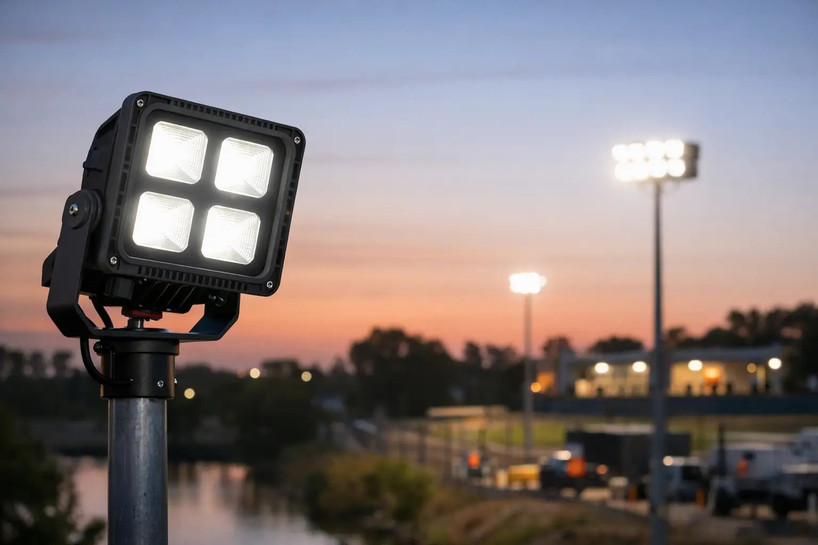
A flood fixture that looks bright from the ground can still leave a dock approach, equipment yard, building perimeter, or parking area poorly lit. The issue is usually not whether the flood lights turn on. It is whether their lumens, beam pattern, mounting position, controls, and environmental rating match the actual task.
For commercial buyers, flood lighting should be specified as part of a working site, not selected as a generic outdoor fixture. A loading dock needs useful vertical light around trailers and doors. A security application needs consistent coverage without creating deep shadows. A sign, facade, or sports area may require a tighter distribution and more careful aiming. The right fixture begins with the area being illuminated and the result the site needs after dark.
Start With the Lighting Objective
Flood lights are broad-application fixtures, but that does not make them interchangeable. Before comparing wattage or sale price, define what must be lit and why. Common objectives include perimeter security, pedestrian visibility, loading activity, vehicle movement, building identification, equipment access, construction work, and outdoor recreation.
A perimeter flood may need to reach a fence line from a building wall or pole. A fixture over a receiving area may need to put light directly onto the dock face, pavement, and trailer connection points. Lighting a large open storage yard requires wider coverage and often higher mounting heights. These are different applications, even when they use the same general fixture category.
Also identify whether the installation is a new layout or a replacement. Replacing a 1,000-watt metal halide fixture with LED is not a one-for-one wattage decision. The older fixture may have lost output over time, used a different optical distribution, or been aimed poorly. Compare delivered light, coverage, mounting height, and beam control rather than matching the legacy wattage alone.
Flood Lights: Lumens Before Watts
Wattage measures energy use. Lumens measure the fixture's initial light output. Both matter, but lumen output is the more useful starting point when evaluating LED flood lights.
A lower-wattage LED fixture can produce substantially more usable light than an older HID fixture while reducing energy and maintenance costs. However, higher lumen output is not automatically better. Excess output can create glare, spill light beyond the property line, and waste energy. It can also make a camera scene harder to read if bright hotspots sit beside dark areas.
For small entry points, walkways, and focused equipment areas, moderate-output fixtures may be sufficient. Larger vehicle yards, sports courts, building perimeters, and high-mounted pole applications often require substantially higher lumen packages. The correct level depends on the target foot-candle requirement, mounting height, fixture spacing, surface reflectance, and expected operating conditions.
Selectable-wattage models are useful when a contractor or facility team needs flexibility at installation. They can help standardize inventory across similar applications and allow output adjustments when site conditions differ from the drawing. The trade-off is that the selected wattage should be documented and verified during commissioning. A fixture left at the wrong setting can create uneven coverage or undermine projected energy savings.
Match the Beam Pattern to the Site
Beam distribution determines where the light goes. It has as much influence on field performance as the lumen rating.
A wide flood beam can cover broad areas from a lower mounting point, but it may throw light outside the intended zone if aimed carelessly. A narrower distribution reaches farther and can concentrate output on a specific target, such as a sign, facade, gate, or distant edge of a lot. For pole-mounted area coverage, asymmetric optics may be more appropriate than a simple symmetrical flood pattern.
Mounting height changes the equation. As a fixture is installed higher, its light spreads over a larger area but arrives at lower intensity. Raising the fixture without changing the output or distribution can create a dim site even though the flood appears to cover more ground. Conversely, a powerful narrow beam mounted too low can cause intense glare for drivers and pedestrians.
Aiming is not a final detail. It is part of the specification. Flood fixtures should be aimed to place useful light on walking surfaces, access points, work areas, and security boundaries while keeping the light source out of normal lines of sight. Avoid tipping fixtures upward simply to increase apparent reach. That approach often sends output into the sky, neighboring properties, or the eyes of people entering the site.
Choose Color Temperature for Visibility and Use
Commercial exterior LED flood fixtures are commonly offered in 3000K, 4000K, and 5000K color temperatures. The right choice depends on the property, the use of the light, and local requirements.
A 5000K fixture provides a cooler, brighter-looking appearance that is frequently used for active commercial yards, industrial facilities, parking areas, and security applications. A 4000K option offers a more neutral appearance and works well at many office, multifamily, retail, and mixed-use properties. Warmer 3000K lighting can be appropriate where visual comfort, neighborhood context, or wildlife-sensitive requirements take priority.
Do not treat color temperature as a security rating. Better security comes from appropriate coverage, controlled glare, reliable operation, and the removal of dark transition zones. A cooler CCT may make a site feel brighter, but it will not correct poor fixture placement or insufficient output.
Verify Electrical, Mounting, and Environmental Requirements
A flood fixture must fit the electrical system and mounting condition already on site. Confirm the available voltage before ordering. Commercial products may support 120-277V, 347-480V, or other ranges, and using the wrong driver voltage can stop an installation before it starts.
Mounting options deserve the same attention. Knuckle mounts offer adjustability for walls, poles, and structural members. Slipfitter mounts are common for round poles and allow angular adjustment. Trunnion mounts work well for surface mounting and precise aiming, while yoke configurations may suit larger sports or industrial floods. The selected mount must be compatible with the structure, pole tenon, junction box, and planned aiming angle.
For outdoor service, review the IP rating, housing construction, lens material, operating temperature range, and corrosion resistance. An exposed coastal, chemical, agricultural, or industrial location may need more than a standard die-cast aluminum fixture. Facilities with washdown exposure, airborne contaminants, or hazardous vapors may require specialized products with appropriate ratings rather than conventional exterior flood lighting.
Surge protection is another practical consideration. Utility disturbances, switching loads, and lightning can damage LED drivers. Integral surge protection may be adequate for some sites, while higher-risk installations can justify added protection at the fixture or electrical panel. This decision depends on the site's electrical history, location, and cost of an outage.
Add Controls That Support the Operation
Photocells, motion sensors, timers, and networked controls can reduce unnecessary runtime, but controls need to match how the property operates. A dusk-to-dawn photocell is straightforward for perimeter and entrance lighting that should run every night. Motion sensing can work for low-traffic areas, but the sensor coverage must account for vehicle approach paths and fixture height.
For warehouses, yards, and managed campuses, scheduling or centralized controls can provide more predictable energy management. They also allow sites to use lower output during inactive hours and full illumination during deliveries, shift changes, or peak traffic. A bi-level strategy can be effective when security coverage is still needed after normal business hours.
Be cautious with controls around security cameras and active loading areas. A sensor that responds too slowly, turns off too soon, or leaves part of a work zone dark creates an operational problem. Always consider required light levels during the full task, not just when an employee first enters the area.
Plan for Maintenance, Code, and Total Cost
LED flood lights reduce relamping frequency, but they are not maintenance-free. Drivers, photocells, sensors, wiring connections, and mounting hardware still need inspection. Choose fixtures with a warranty, accessible service components where needed, and a build quality appropriate for the expected duty cycle.
Check local ordinances, property requirements, and project specifications before purchase. Requirements may address light trespass, shielding, maximum mounting heights, curfews, color temperature, energy codes, or dark-sky considerations. Projects serving public facilities, schools, municipalities, or regulated industrial environments may carry additional specification requirements.
The lowest fixture price can become expensive if it produces poor coverage, requires early replacement, or causes a failed inspection. Consider fixture cost alongside energy draw, expected operating hours, installation labor, control compatibility, warranty coverage, and the cost of accessing the fixture for future service.
For projects with several mounting heights or task areas, a simple lighting layout and fixture schedule can prevent costly field changes. Record the fixture model, lumen package, CCT, voltage, mounting type, aiming direction, control setting, and circuit location. That information makes future maintenance and expansions much easier.
A well-specified flood fixture should disappear into the operation: crews can work safely, visitors can find their way, cameras can see clearly, and the site does not waste light where it is not needed. When product choices need to cover standard exterior applications and specialized commercial conditions, Last Stop Lighting can help buyers narrow the options to fixtures that fit the job rather than simply fill a catalog category.