
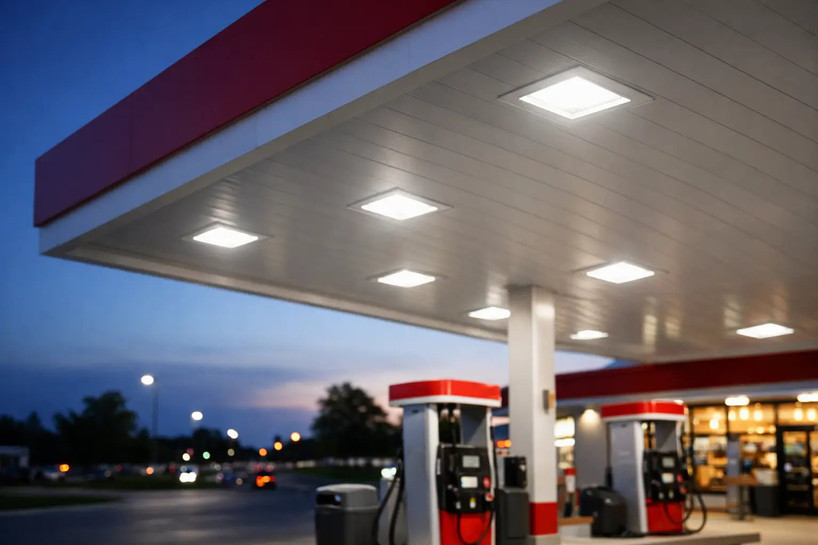
A fuel island that looks dim at 2:00 a.m. creates more than a poor first impression. It can make pump controls harder to read, reduce camera clarity, create perceived safety issues, and send customers to a brighter competitor across the street. The right gas station canopy lights put usable light exactly where drivers, attendants, payment terminals, and security systems need it while controlling energy and maintenance costs.
For replacements or new construction, the goal is not simply to install the highest-wattage fixture available. Canopy height, bay spacing, ambient light conditions, mounting conditions, electrical supply, and local requirements all affect the right selection. A commercial LED canopy fixture should be evaluated as part of the entire forecourt lighting plan.
Start With the Canopy Layout
The fixture count and placement on the underside of the canopy establish the lighting pattern. Before ordering, document the canopy length and width, the number of fueling positions, column locations, mounting openings, and the distance from the finished pavement to the fixture plane. A layout that works under an 18-foot canopy may not produce the same results at 14 or 22 feet.
Existing fixture locations are useful, but they should not automatically dictate the replacement plan. Older metal halide or high-pressure sodium fixtures often required more wattage and may have been placed to compensate for uneven output. LED fixtures can improve uniformity, but only when their distribution and spacing suit the structure.
A lighting layout or photometric review is especially worthwhile when the project involves a new canopy, a major renovation, unusually tall mounting heights, or a customer complaint about dark zones. Raw lumen output does not show where light lands. Foot-candle levels and uniformity across the fueling surface do.
Lumen Output and Wattage Are Not Interchangeable
When comparing LED canopy fixtures, lumen output is the more useful performance number. Wattage indicates how much power the fixture consumes; lumens indicate the amount of visible light it produces. Two 100-watt fixtures can deliver substantially different lumen packages depending on LED efficacy, driver design, and optical system.
For many standard gas station canopies, LED fixtures in the roughly 10,000- to 20,000-lumen range may be considered, but that range is not a specification by itself. A lower mounting height, close fixture spacing, and a smaller canopy can require less output. A tall canopy over wide traffic lanes or large diesel islands can require more.
Selectable-wattage canopy lights can simplify replacement work when the final output requirement is uncertain. They allow the installer to set the fixture output before commissioning rather than carrying several fixed-output models. The trade-off is that the selected setting must be documented and applied consistently across the canopy. A mixed set of field settings can create visible bright and dim patches.
Choose the Right Gas Station Canopy Light Construction
Fueling canopies are exposed commercial environments. Fixtures face vibration, heat, cold, humidity, wind-driven rain, airborne dust, vehicle exhaust, and frequent switching. A residential-grade outdoor light is not an appropriate substitute.
Look for a commercial LED canopy fixture with a durable die-cast housing, corrosion-resistant finish, a sealed optical compartment, and a listed wet-location rating when the installation is exposed to weather. IP65 or similar ingress protection may be appropriate for many applications, although the project specification and local authority should determine the required rating. For coastal areas or sites exposed to deicing chemicals, corrosion resistance deserves additional attention.
Lens material also matters. Clear lenses can maximize output, while frosted or diffused optics can help reduce glare and improve visual comfort below the canopy. The right choice depends on mounting height, fixture spacing, and the amount of direct brightness visible to customers approaching the pumps.
Do not confuse a standard canopy light with equipment rated for hazardous locations. The underside of a typical open fueling canopy does not automatically require explosion-proof lighting, but classified areas, enclosed spaces, maintenance rooms, and site-specific engineering conditions can change the requirement. Follow the electrical plan, applicable codes, and the authority having jurisdiction rather than making assumptions based on fixture appearance.
Match Mounting and Electrical Requirements Before Ordering
Canopy fixtures are commonly recessed into an existing opening, surface-mounted to the canopy deck, or installed with a pendant arrangement. The replacement must match the structure or include the correct mounting accessories. Measure cutout dimensions, fixture depth above the canopy, mounting-hole pattern, and clearance around conduit or wiring before selecting a recessed unit.
Surface-mount fixtures are often a practical answer when existing openings do not match current products or when the canopy deck cannot support recessed installation. They can also speed renovation work, but the exposed profile should be acceptable for the site and protected from impact where needed.
Verify input voltage at each circuit. Commercial canopy lights are frequently available in 120-277V or 120-347V configurations, and some projects use 480V through an appropriate driver arrangement. Selecting a fixture with the wrong voltage range can delay the job or damage the product at energization. Confirm whether the site has a neutral conductor, how circuits are switched, and whether emergency power is involved.
If fixtures are being replaced one-for-one, inspect the branch circuits and junction boxes rather than assuming they are in good condition. Aging conductors, water intrusion, deteriorated gaskets, and overloaded circuits can undermine an otherwise solid LED upgrade.
Select Color Temperature for Visibility, Not Trend
Most commercial fueling locations use 4000K or 5000K LED canopy lighting. Both provide a clean white appearance that supports task visibility and camera performance. The better choice depends on the brand standard, surrounding site lighting, customer preference, and the visual character of the property.
A 4000K fixture generally appears more neutral and can feel less stark under a lower canopy. A 5000K fixture has a cooler appearance and is often selected for a brighter visual impression. Neither color temperature automatically delivers more useful light. The lumens, optics, and layout still determine performance.
Color rendering index can matter when attendants need to identify vehicle colors, read labels, or work with merchandise near the fuel island. For standard exterior illumination, a commercially appropriate CRI may be sufficient. Sites with specific visual or branding requirements may benefit from a higher-CRI product, though it can affect product availability and price.
Use Controls Without Creating Customer Friction
Photocells, occupancy sensors, daylight harvesting, and networked controls can reduce operating hours and support maintenance monitoring. Their value depends on how the canopy is used. A 24-hour site with constant vehicle activity has different control opportunities than a closed overnight station with intermittent traffic.
A photocell or centralized time clock can ensure exterior lighting operates at the intended hours. Occupancy sensors may be useful for service areas or low-use zones, but aggressive dimming beneath active pumps can make customers feel unsafe or create uneven camera images. If sensors are used, set a sensible standby level, timeout, and ramp behavior.
Controls should also be compatible with the LED drivers. Not every fixture supports every dimming protocol, sensor module, or control voltage. Confirm whether the product is non-dimming, 0-10V dimming, sensor-ready, or supplied with an integrated photocell before purchase.
Build the Purchase Specification Around Service Life
An LED upgrade is supposed to reduce maintenance visits, not shift failures from lamps to drivers. Review the fixture warranty, rated life information, driver replaceability, operating temperature range, surge protection, and availability of matching replacement units. A low upfront price is less attractive if the fixture cannot be sourced again for a phased repair two years later.
For multi-site operators, standardizing on a small number of approved canopy models can reduce stocking complexity and create a consistent nighttime appearance. Contractors should also retain fixture settings, installation dates, circuit information, and warranty documentation for each location.
Before issuing the order, verify these project details:
- Required lumen output, distribution, and target light levels
- Mounting type, opening dimensions, and canopy clearance
- Input voltage, dimming method, and control compatibility
- Wet-location rating, environmental exposure, and any site-specific code requirements
- Selected wattage and color temperature for every fixture
Last Stop Lighting can help commercial buyers compare canopy fixture specifications, voltage options, selectable wattage packages, and project quantities before equipment reaches the jobsite. The best time to resolve a mounting or control mismatch is during product selection, not after a lift is booked and the canopy is opened.