
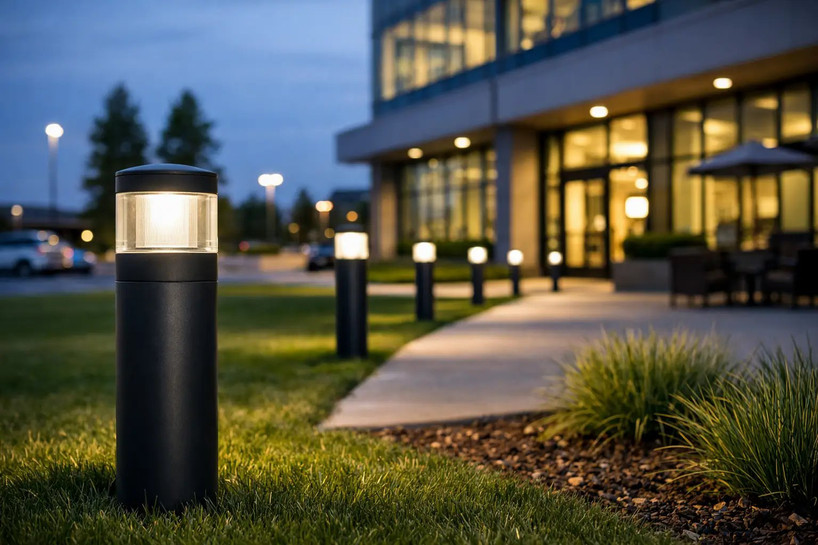
A poorly lit pedestrian route creates problems long before anyone calls it a lighting problem. Uneven light at a building entrance, dark gaps between parking and a front door, and glare at eye level can affect safety, accessibility, tenant perception, and after-hours operations. The right LED bollard light provides commercial properties with low-level pathway illumination without adding tall poles or relying solely on wall-mounted fixtures.
Bollards are not decorative substitutes for area lighting. On a commercial site, they are functional fixtures used to define walking routes, illuminate transitions, guide visitors, and add controlled light where pole fixtures cannot deliver it effectively. The selection process starts with the path and the required light distribution, then moves to output, construction, controls, and electrical requirements.
Start With the Application, Not the Fixture Shape
An LED bollard is typically installed along sidewalks, plazas, building entries, landscaped paths, parking-lot walkways, courtyards, and pedestrian routes between separate structures. It can also work at healthcare campuses, multifamily properties, schools, hospitality sites, retail centers, and public-facing facilities where clear wayfinding matters.
The key question is what the fixture needs to illuminate. A narrow sidewalk may need a forward-throw distribution that places light across the walking surface without wasting output behind the bollard. A broad plaza or entry apron may benefit from a wider distribution. A fixture that looks appropriate at daytime can produce poor nighttime results if its optic does not match the path geometry.
Bollards generally supplement, rather than replace, parking lot poles, wall packs, or flood lights. Pole-mounted area fixtures handle larger zones and vehicle areas. Bollards improve the pedestrian-scale layer of the lighting plan. Treating those two jobs as interchangeable often leads either to underlit paths or excessive brightness and glare.
Choose an LED Bollard Light by Distribution
Optics have a direct effect on spacing, visual comfort, and usable light on the ground. Commercial buyers should review photometric data whenever the project involves a new layout, an unfamiliar fixture, or a site with safety-sensitive pedestrian circulation.
A louvered or shielded bollard controls light near the source and can reduce visible glare. This is useful near entrances, seating areas, residential-facing spaces, and routes where people approach the fixture at close range. The trade-off is that shielding can reduce the amount of light reaching farther from the unit, requiring tighter spacing or higher output.
A 360-degree distribution sends light around the fixture and is often selected for open pedestrian areas, courtyards, and landscape paths. A directional or asymmetric distribution is better suited to paths with a defined travel direction, such as a sidewalk beside a parking area or a walkway along a building. Full cutoff or low-glare configurations are worth prioritizing when light trespass, dark-sky requirements, or visual comfort are part of the specification.
Do not select based on lumens alone. Two bollards with similar lumen ratings can perform very differently because of their lens design, shielding, mounting height, and distribution pattern.
Match Output and Spacing to the Site
Most bollard fixtures are intended for low-level illumination, not high-output security coverage. The right lumen package depends on ambient light, path width, surrounding surfaces, fixture spacing, and the required foot-candle level. A darker site with asphalt walks and few nearby fixtures may need more output than a bright concrete entry under canopy lighting.
As a practical approach, determine the minimum light level required at the walking surface, then use the fixture's photometric report to establish spacing. Avoid the shortcut of placing bollards at equal intervals based only on visual preference. A consistent layout may still leave dark areas between fixtures, especially on wider paths or around curves.
Consider these conditions during layout:
- Path width, surface reflectance, and changes in elevation
- Intersections, steps, ramps, curb cuts, and door approaches
- Existing pole, wall, canopy, or landscape lighting
- Tree growth, planted materials, parked vehicles, and snow accumulation
- Local ordinances, property standards, and any dark-sky limitations
More fixtures at lower output can produce better uniformity and less glare than widely spaced, high-output units. That approach can raise fixture and installation costs, though, so the correct balance depends on the project budget and performance target.
Specify Construction for Outdoor Service
Commercial bollards live close to the ground, where they are exposed to irrigation, deicing chemicals, lawn equipment, carts, impact, and standing water. Housing construction matters. Die-cast aluminum or heavy-gauge aluminum housings with a durable powder-coat finish are common choices for general outdoor use. In coastal locations or chemically aggressive environments, verify corrosion resistance and finish suitability rather than assuming a standard painted housing will hold up.
An appropriate wet-location listing is essential for exterior installations. Check the fixture's IP rating when dust and water ingress are significant concerns. Higher impact resistance can also be valuable in schools, transit areas, public sites, and locations with frequent equipment traffic.
Finish selection is more than an appearance choice. Bronze, black, gray, and architectural colors may be needed to match poles, railings, or site furnishings, but the finish should also be suitable for ultraviolet exposure and the local environment. If a project has strict visual standards, confirm that replacement fixtures will remain available in the required finish.
Verify Height, Base, and Mounting Details
Most commercial bollards stand roughly 30 to 42 inches above grade, though dimensions vary. Height affects both light distribution and the fixture's visibility to pedestrians and vehicles. A taller bollard can throw light farther, while a shorter design may be less visually intrusive in landscaped areas. Neither is automatically better.
Installation details should be reviewed before ordering. Many hardscape-mounted bollards use an anchor-bolt base and require a concrete foundation, conduit stub-up, and correctly located bolt pattern. Others may use a direct-burial configuration. A replacement project can become expensive if the new base plate does not align with existing anchor bolts or if the bolt circle is not confirmed in advance.
Check the overall height, base diameter, anchor-bolt template, mounting hardware, wire access, and required foundation dimensions. For retrofit work, verify whether the existing concrete pad is sound and whether conduit placement will interfere with the new fixture's internal wiring compartment.
Select Color Temperature With the Surrounding Site in Mind
For commercial exterior applications, 3000K, 4000K, and 5000K are common LED color temperature options. The correct choice depends on the site and neighboring lighting, not a universal preference.
A 3000K bollard provides a warmer appearance that can work well around hospitality properties, multifamily courtyards, pedestrian plazas, and architectural landscapes. A 4000K fixture offers a more neutral white light and is frequently used where visual clarity and consistency with commercial exterior lighting are priorities. A 5000K option creates a cooler, brighter-looking appearance, but it may feel harsh at close range or conflict with warmer building and landscape lighting.
When replacing only part of an existing installation, match the current color temperature as closely as possible. Mixed CCTs are noticeable along a continuous route and can make a completed project look pieced together. Selectable-CCT bollards can simplify stocking and field decisions, but confirm the chosen setting before final installation.
Controls Can Reduce Operating Cost Without Reducing Safety
Photocells, occupancy sensors, timers, and networked controls can improve energy performance, especially where pedestrian activity changes through the night. Dusk-to-dawn operation is common for exterior bollards because pathways need predictable illumination after dark. In low-traffic areas, a sensor-based dimming strategy may reduce energy use while maintaining a higher output when motion is detected.
Controls must fit the application. A sensor that turns fixtures fully off may not be appropriate for a required egress path, a public entry, or a site where continuous wayfinding light is expected. Likewise, independently controlled fixtures can create inconsistent operation if photocells are shaded differently by trees, canopies, or nearby buildings.
For larger properties, coordinate bollard controls with poles, wall packs, canopy fixtures, and building automation schedules. A site that uses multiple control methods without coordination often creates dark transitions between lighting zones.
Confirm Electrical and Maintenance Requirements
Verify input voltage before purchase. Many commercial LED bollards operate on 120-277V, which supports typical commercial branch circuits, while some projects require 347-480V equipment or a dedicated low-voltage landscape lighting system. Do not assume voltage compatibility based on fixture appearance.
Review driver accessibility, surge protection, expected LED life, warranty terms, and availability of replacement components. Integrated LED designs reduce routine lamp replacement, but a facility team still needs a practical plan for damage, driver failure, and future matching fixtures. Keeping a small number of spares can be worthwhile for properties with standardized exterior lighting.
Emergency battery backup is not standard in most bollards and should not be assumed to satisfy emergency egress requirements. Where code-required emergency lighting is needed, coordinate the design with properly listed emergency fixtures and the applicable electrical and life-safety requirements.
A well-specified bollard does more than light a sidewalk. It helps visitors see where to walk, helps facility teams maintain a consistent site standard, and gives contractors a fixture that can be installed and serviced without surprises. For projects that need a clear specification review, Last Stop Lighting can help buyers compare commercial-grade bollard options by output, voltage, distribution, finish, and application.