
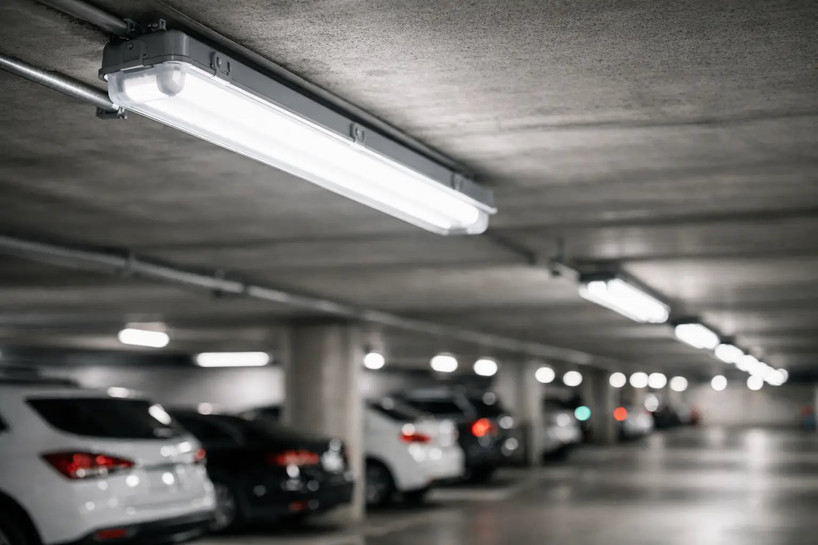
A garage can look adequately lit from the drive lane and still leave drivers, pedestrians, payment areas, stair doors, and parked vehicles in poor visibility. Parking garage ceiling lights need to do more than fill an open area with lumens. They need to create useful vertical and horizontal illumination, limit glare, withstand a dirty environment, and support safe movement at every hour of operation.
For a new build, retrofit, or replacement project, the right answer depends on ceiling height, deck construction, garage layout, operating hours, controls, and local life-safety requirements. A fixture that performs well in a small enclosed lower level may be the wrong fit for an open-air upper deck exposed to wind, moisture, and vehicle exhaust.
Start With the Garage Layout, Not Fixture Wattage
Wattage is a power-consumption figure, not a lighting plan. It is useful when estimating electrical load and energy cost, but it does not tell a buyer whether a fixture will deliver enough usable light across a driving lane or at the face of a wall-mounted sign. Lumen output, distribution pattern, mounting height, spacing, and surface reflectance all matter.
Begin by separating the garage into functional zones. Drive aisles, parking bays, pedestrian paths, elevator lobbies, stairwell entrances, ramps, payment stations, and mechanical rooms do not all have the same illumination needs. Ramps and transitions deserve special attention because drivers need time to identify surface changes, pedestrians, and vehicles entering their path. Doorways, call stations, and emergency equipment also need enough light on vertical surfaces to be readily identifiable.
Low concrete ceilings often call for wide-distribution, low-profile LED canopy fixtures or vapor-tight fixtures mounted directly to the deck. Taller open garages may use pendant-mounted LED fixtures when structure and clearance allow. The goal is consistent coverage without creating bright pools beneath fixtures and dark gaps between them.
Before selecting a replacement fixture, document the existing mounting height and spacing. If an older high-wattage metal halide fixture is being replaced with a lower-wattage LED product, do not assume a one-for-one swap will produce the same distribution. LEDs are directional, which is an advantage when the optics suit the application and a problem when they do not.
Choose Parking Garage Ceiling Lights for the Environment
Parking structures are hard on lighting equipment. Dust, road salt, humidity, vibration, exhaust residue, and occasional impact can shorten the life of poorly matched fixtures. A commercial fixture should be selected for its enclosure, construction, and rating as carefully as its output.
For enclosed levels, LED vapor-tight fixtures are often a practical choice where moisture, dirt, or washdown exposure is a concern. Their sealed housings and diffused lenses can provide broad, uniform lighting along aisles and between parking rows. Surface-mount LED canopy fixtures are another common option for concrete decks, especially where a clean, compact profile is preferred.
Open-air garages require additional attention to wet-location suitability. Rain can reach fixtures through open sides, and wind-driven moisture may affect areas that appear protected at first glance. In coastal regions or garages treated heavily with deicing salts, corrosion resistance matters. Specify housing finishes, gasketing, lens material, and hardware appropriate for the exposure rather than relying on an indoor-rated general-purpose fixture.
Impact exposure is another real consideration. Fixtures installed at lower elevations near service areas, loading zones, or areas with high-clearance vehicles may need stronger housings or protective guards. The lowest price fixture can become the expensive option when recurring lens damage, driver failures, or replacement labor are added to the operating cost.
Get Light Levels and Glare Under Control
More output is not automatically better. Excessive brightness can create reflected glare on polished concrete, vehicle windshields, wet pavement, or painted surfaces. It can also make adjacent areas appear darker by comparison. Drivers need visual comfort and contrast, not just a high lumen number on a specification sheet.
Consider the fixture's distribution and lens design. A broad, diffuse distribution generally works well for low ceilings and open parking areas. More focused optics may be useful at ramps, entrances, or tall mounting heights where light must reach a defined surface. Frosted or diffused lenses can reduce visual harshness, although they may trade some fixture efficiency for comfort and uniformity.
Color temperature should support visibility without making the structure feel excessively stark. Many commercial garages use 4000K for a neutral white appearance and strong visual clarity. A 5000K option may suit open or high-activity facilities where a cooler appearance is desired, but it can feel harsher in enclosed concrete spaces. Selectable-CCT fixtures can simplify purchasing when the final preference has not been established, provided the chosen setting is documented during commissioning.
Color rendering also has practical value. Better color rendering helps security personnel, maintenance staff, and users distinguish vehicle colors, signage, clothing, spills, and surface markings. It is not the only specification to evaluate, but it should not be ignored in security-sensitive facilities.
Plan for Dark Walls and Low Reflectance
Concrete absorbs and scatters light differently than white-painted ceilings and walls. A garage with unpainted decks, dark columns, and limited daylight may require more careful spacing than a cleaner, high-reflectance structure. Light calculations or photometric layouts are especially valuable for large projects, unusual floor plans, renovations that change ceiling conditions, and garages with recurring visibility complaints.
A field survey should capture at least four details before ordering: mounting heights, fixture spacing, supply voltage, and the condition of the existing wiring and junction boxes. Also note obstructions such as ducts, beams, signs, cameras, sprinklers, and vehicle-clearance bars. Those details prevent a product selection that looks correct on paper but creates installation problems on site.
Use Controls Where They Reduce Real Operating Cost
Garages commonly operate for long hours, and many remain illuminated continuously. LED upgrades reduce energy use immediately, but controls can add further savings when they are matched to actual occupancy and safety expectations.
Occupancy sensors are useful in low-traffic zones, storage areas, remote stair connections, and portions of a garage that are not constantly active. Bi-level dimming is often more appropriate than full shutoff. The fixture operates at a reduced output when the space is vacant, then increases to full output when motion is detected. This maintains a visible baseline and avoids sudden darkness for drivers or pedestrians.
Daylight harvesting can make sense on open perimeter levels where sunlight provides meaningful daytime illumination. It is less useful in deep interior bays with inconsistent daylight. Networked controls can provide scheduling, zoning, reporting, and centralized adjustments, but they add equipment and commissioning cost. For a small garage with predictable use, integral motion sensors or simple photocells may deliver better value.
Do not let control settings compromise perceived safety. A low-level setting that looks acceptable during commissioning can feel inadequate at night, in rain, or when surrounding areas are dark. Test settings under real operating conditions and give facility staff a clear record of programmed levels, time delays, and override procedures.
Separate General Lighting From Emergency Coverage
Normal parking-garage lighting and emergency illumination serve related but different functions. General fixtures support everyday visibility and wayfinding. Emergency lighting supports safe egress during a power interruption, subject to the applicable building, fire, and electrical codes.
Some LED garage fixtures are available with integral emergency battery backup. These can be efficient in a retrofit because a single fixture provides normal and emergency operation. However, battery-backed fixtures should be placed strategically and tested regularly. Their emergency output is typically lower than normal output, so the emergency lighting plan must be evaluated in battery mode, not only when utility power is available.
Dedicated emergency lights, exit signs, and remote heads may still be required based on the facility layout and local code interpretation. Stairwells, exit routes, elevator lobbies, and areas near exit discharge points deserve focused review. Coordinate the lighting package with the authority having jurisdiction and the project's electrical plans. Product ratings and battery backup features support compliance, but they do not replace a code-based layout.
Buy for Maintenance Access and Service Life
An LED fixture with a long rated life is valuable only if it can remain in service in the actual garage environment. Consider access equipment, lift costs, traffic control, and the disruption required to change a fixture above active parking spaces. A higher-quality commercial fixture with a dependable driver, suitable thermal design, and clear warranty terms can reduce long-term maintenance calls.
Standardizing fixture families across a property portfolio can simplify stocking, training, and replacement. Still, standardization should not force one fixture into every location. A vapor-tight fixture may be the workhorse for parking levels, while a canopy light, wall pack, or dedicated emergency product better serves an entrance, stair tower, or payment area.
For project quantities, Last Stop Lighting can help buyers compare commercial LED fixture options by wattage, lumens, voltage, color temperature, mounting style, sensor capability, and emergency backup needs. The best purchase starts with accurate site information, then matches the product to the deck, the traffic pattern, and the maintenance plan.
A garage lighting upgrade earns its value when drivers see clearly, pedestrians feel safer, maintenance teams make fewer service calls, and operating costs fall without leaving dark corners behind.