
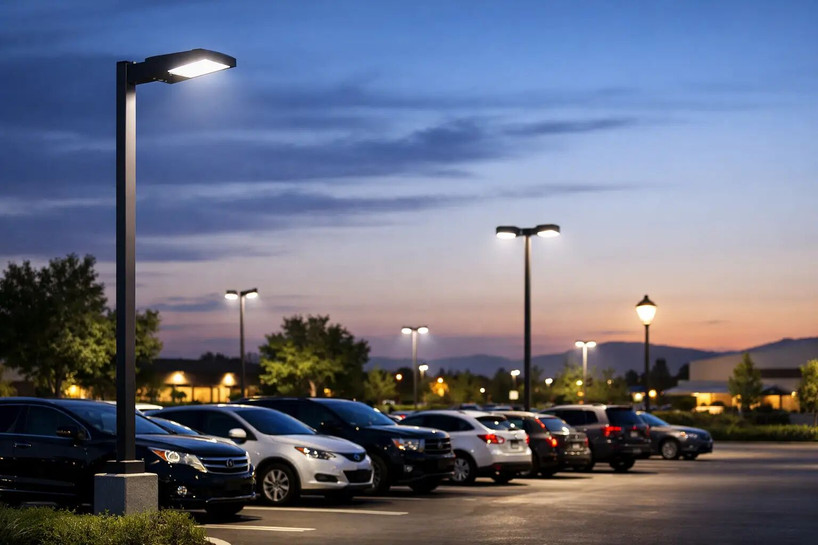
A parking lot that looks bright from the street can still have dark pedestrian paths, harsh glare at entrances, or uneven coverage between rows of vehicles. Effective parking lot lighting selection is not a matter of choosing the highest-wattage fixture. It is a site-specific decision based on the lot layout, mounting height, operating hours, security needs, local requirements, and the light levels people actually experience on the ground.
For contractors, property managers, and commercial buyers, the goal is straightforward: provide dependable visibility with LED fixtures that control operating cost, minimize maintenance, and fit the installation without costly changes in the field.
Start With the Parking Lot Layout
Before comparing wattage, review the site plan. Count parking spaces, identify drive lanes, note entrances and exits, and mark sidewalks, loading areas, dumpster enclosures, pay stations, building entrances, and property edges. These areas do not all need the same amount of light.
A small retail lot with 20-foot poles has different fixture needs than a hospital lot with multiple pedestrian routes or a distribution center that operates overnight. Pole spacing, pole height, fixture placement, nearby buildings, trees, and existing electrical circuits all affect the final layout.
Look beyond the main parking field. The most common lighting gaps occur at transitions: a walkway from the lot to the building, a drive-through lane, a rear employee entrance, or the perimeter behind a row of parked cars. A photometric plan helps confirm that the proposed fixtures deliver usable illumination across the whole site rather than creating bright pools with dim areas between them.
Set Light Levels for the Actual Use of the Property
Light level is generally measured in footcandles on the parking surface. Higher footcandle levels can improve visibility in active, high-security, or late-night settings, but more light is not automatically better. Excess output increases energy use, can produce glare, and may conflict with local lighting ordinances.
A low-traffic employee lot may need a lower maintained light level than a busy medical office, retail center, multifamily property, or 24-hour facility. Entrances, pedestrian crossings, accessible routes, and payment areas often require more attention than standard parking stalls. The right target also depends on ambient light from storefronts, nearby streets, and adjacent properties.
Use maintained values, not just the fixture’s initial performance. LED output gradually declines over time, and dirt accumulation can reduce delivered light. A layout should account for these factors so the lot remains adequately lit through the fixture’s service life.
Uniformity matters as much as average footcandles. A high average reading can hide very dark spots. Review minimum footcandles and the average-to-minimum ratio to see whether light is distributed consistently. Better uniformity helps drivers identify pedestrians, curbs, wheel stops, and vehicle movement without having to adjust repeatedly between bright and dark zones.
Choose Fixture Distribution Before Fixture Wattage
Parking lot LED area lights are available with multiple optical distributions. The distribution determines where the fixture sends its light. Wattage and lumen output determine how much light is available, but the optic determines whether that light reaches the intended area.
Type III distributions are commonly used along lot perimeters and roadways because they project light forward and outward. Type V distributions provide a more symmetrical pattern and often work well when fixtures are mounted near the center of a parking area. Type IV options can suit perimeter applications where light must be pushed into the lot while reducing spill behind the pole.
The best selection depends on the pole location. A Type V fixture on an edge-mounted pole can waste light outside the property, while a forward-throw optic on a center pole may leave coverage gaps. For projects with unusual geometry, a photometric layout is far more reliable than selecting a distribution by habit.
Match Lumens to Mounting Height and Pole Spacing
LED area lights are often compared by wattage, but lumens, distribution, and mounting geometry should lead the decision. A 100W LED area light may be appropriate for a smaller lot or lower mounting height, while 200W, 300W, and higher-output fixtures can be needed for tall poles, wide spacing, or large open areas.
As mounting height increases, the fixture must send light farther to maintain coverage. That can require more lumen output, a different optic, or both. Higher poles may reduce the number of poles required, but they can also increase glare risk and make maintenance more involved. Reusing existing poles is often cost-effective when their height, condition, and spacing work with the new LED layout.
Check the fixture’s mounting options early. Slipfitter mounts, adjustable arm mounts, direct pole mounts, and yoke mounts serve different installation conditions. A mismatch between the fixture mount and the existing pole or tenon can delay a project and add unnecessary field labor.
Control Glare, Spill Light, and Light Trespass
A fixture can meet a footcandle target and still create complaints if it shines directly into drivers’ eyes, neighboring windows, or nearby roads. Glare is especially relevant at property entrances, intersections, and locations where drivers approach a pole head-on.
Choose full-cutoff or properly shielded LED area fixtures where practical. Confirm the fixture’s BUG rating, which evaluates backlight, uplight, and glare, when the project must meet dark-sky restrictions or a municipal lighting ordinance. Backlight control is particularly useful on property lines, while uplight limits help reduce sky glow.
Color temperature also affects how a lot feels and performs. Many commercial parking applications use 4000K or 5000K LED fixtures for clear visibility. A 4000K option may be a better fit for multifamily, hospitality, or locations with stricter neighborhood expectations. A 5000K fixture can provide a crisper appearance in active commercial and industrial sites. Check local requirements before standardizing on a color temperature, since some jurisdictions limit high-CCT outdoor lighting.
Specify Electrical and Environmental Requirements
Verify voltage before ordering. Many commercial LED parking lot fixtures operate on 120-277V, which suits standard commercial circuits. Larger facilities may require 277-480V fixtures. Do not assume a universal voltage range covers every site.
For outdoor use, select fixtures with an appropriate wet-location rating. A durable die-cast housing, corrosion-resistant finish, and suitable IP rating matter in rain, snow, coastal conditions, and high-dust environments. Review the fixture’s operating temperature range for northern climates, desert heat, or locations exposed to significant temperature swings.
Surge protection deserves attention on pole-mounted outdoor lighting. Electrical storms, utility disturbances, and switching events can damage LED drivers. Built-in surge protection is valuable, and some projects justify higher-kV protection or field-replaceable surge devices. A modest upfront investment can prevent premature failures across an entire lot.
Use Controls to Reduce Operating Cost Without Creating Dark Areas
LED lighting already cuts energy consumption compared with legacy HID systems, but controls can add meaningful savings. Photocells turn fixtures on at dusk and off at dawn. A photocell may be built into the fixture, installed as a receptacle-mounted accessory, or controlled centrally depending on the site.
Motion or occupancy sensors are useful in low-traffic areas, but they need careful programming. For example, a fixture may dim to a lower output after business hours and return to full output when motion is detected. This approach can work well for remote lots, rear areas, and employee parking, provided the low-level setting still supports safe orientation and camera visibility.
Selectable wattage and selectable color temperature fixtures offer flexibility during installation and future maintenance. They are useful when a site has similar fixtures with slightly different coverage needs. Still, field-selectable settings are not a replacement for a photometric design. Set the wattage deliberately, label the final setting, and keep that information with the maintenance records.
Build the Project Around Total Cost, Not Fixture Price Alone
The lowest-priced fixture is not always the lowest-cost project. Consider labor, pole modifications, lift equipment, wiring changes, controls, warranty coverage, expected driver life, and the cost of future service calls. Replacing a failed fixture on a 30-foot pole costs more than replacing one over a side entrance.
For retrofit work, inspect existing poles, brackets, foundations, and electrical connections before finalizing the order. Rusted poles, damaged tenons, undersized conductors, and obsolete photocell controls can affect both schedule and budget. If the existing layout was designed for metal halide or high-pressure sodium fixtures, LED optics may improve coverage, but the new fixtures should still be evaluated as a complete system.
A purchasing package should clearly identify fixture model, lumen package, distribution, voltage, mounting method, color temperature, controls, surge protection, and any required accessories. That level of detail prevents substitutions that look similar on paper but do not perform the same way on the pole.
A Practical Parking Lot Lighting Selection Checklist
Before placing an order, confirm these project details:
- Pole locations, mounting heights, spacing, and existing mount types
- Required footcandle levels and acceptable uniformity for each area
- Fixture distribution, lumen output, color temperature, and glare control
- Input voltage, wet-location rating, surge protection, and operating environment
- Photocell, sensor, dimming, or centralized control requirements
- Local code, dark-sky, property-line spill light, and permitting requirements
Last Stop Lighting can help commercial buyers narrow LED area light options by application, wattage, voltage, mounting style, and control features. For larger projects, bring the site dimensions and pole information to the conversation early. The right fixture is easier to purchase when the layout has already answered where the light needs to go.