
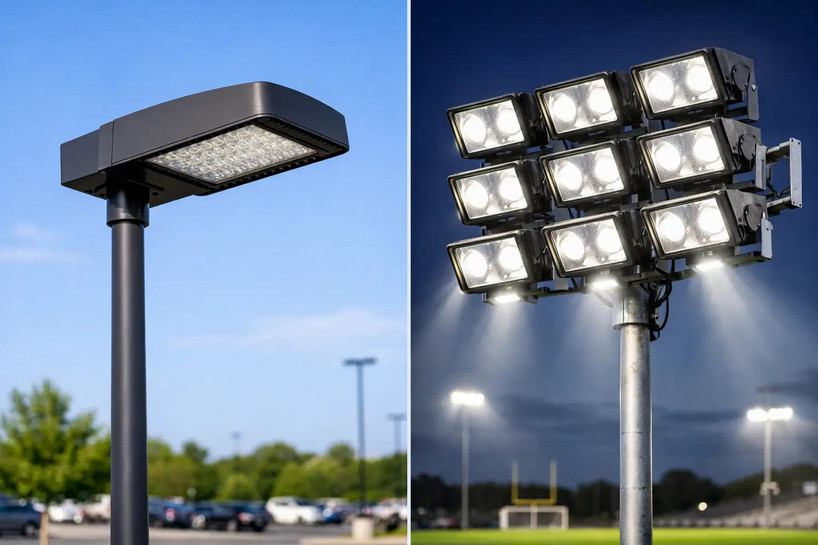
A parking lot with bright hot spots, dark driving lanes, and light spilling into neighboring property usually has a fixture selection problem, not simply a lumen problem. In the shoebox versus flood lighting decision, the right answer comes down to where light must go, how evenly it must be distributed, and how much control the site requires after dark.
Shoebox fixtures and LED flood lights can both deliver high output, long service life, and lower energy use than legacy HID lighting. Their optics, mounting options, and intended coverage patterns are different. Choosing based only on wattage or fixture price can leave a commercial site underlit, overlit, or exposed to glare complaints.
Shoebox Versus Flood Lighting by Application
A shoebox light is an area-light fixture designed to distribute light broadly and predictably across horizontal surfaces. It is commonly pole-mounted for parking lots, private roads, drive lanes, walkways, apartment complexes, retail centers, campuses, and vehicle yards. The rectangular housing gives the fixture its name, but the optics are what make it an area light.
A flood light projects a more concentrated beam toward a target. It is commonly mounted on buildings, poles, trusses, or ground-mounted structures to illuminate facades, loading areas, signs, storage yards, sports courts, equipment, perimeter zones, and work areas. A flood fixture may have a wide, medium, narrow, or adjustable beam pattern depending on the product.
The practical distinction is simple: use a shoebox fixture when the goal is consistent coverage across a defined area. Use a flood light when the goal is to direct light at a specific object, zone, or vertical surface. Some sites need both. A retail property may use pole-mounted shoebox lights for customer parking and flood lights at receiving doors, dumpster enclosures, building signage, and loading docks.
Start With the Surface You Need to Light
The first question is not, "Which fixture has more lumens?" It is, "What surface needs usable light?" Parking stalls, traffic lanes, and pedestrian paths are horizontal tasks. They generally benefit from the wide, controlled distribution of LED shoebox lighting. The objective is relatively uniform foot-candle levels with enough visibility between poles, not a bright circle directly below every fixture.
Flood lighting is often better for vertical or targeted tasks. A facility may need to light a roll-up door, a service entrance, a wall-mounted sign, a fenced equipment area, or a shipping yard that extends beyond the normal parking layout. A properly aimed flood light puts output where work, surveillance, access, or safety demands it.
Height also changes the answer. A shoebox fixture mounted at 20 to 30 feet can cover a substantial parking area when paired with the right distribution type and pole spacing. A flood light installed at that same height may create strong illumination in one direction but less consistent coverage across adjacent pavement. Conversely, a flood mounted low on a building can be highly effective at 10 to 20 feet from a loading door, where a pole-mounted area light would be impractical.
Optics Matter More Than Fixture Shape
Commercial buyers should compare photometric distribution, not just fixture appearance. Shoebox fixtures are often offered with Type II, Type III, Type IV, or Type V distributions. Each pattern sends light differently from the pole.
Type II is narrow and forward-throwing, often used along pathways or narrow drive lanes. Type III sends light forward and outward, making it a common choice for parking lot perimeter locations. Type IV pushes light farther forward, which can work well when poles sit near a property edge. Type V is a more circular distribution suited to central parking areas or open lots.
Flood lights are commonly specified by beam angle. A narrow beam concentrates output for long throws and tall structures. A medium beam suits many loading areas and exterior work zones. A wide beam covers broader targets at shorter distances. Flood optics may be available with visors, glare shields, adjustable heads, or precision aiming options, all of which can matter near public roads, occupied buildings, and property lines.
This is why equal wattage does not mean equal performance. A 150-watt LED shoebox and a 150-watt LED flood can produce similar lumen packages while creating entirely different light patterns on the ground. Review the fixture photometric file, mounting height, and aiming angle before treating them as substitutes.
Compare Mounting, Aiming, and Maintenance
Shoebox lights are built around standard outdoor area-light mounting methods. Common options include slip fitter mounts for round poles, direct arm mounts, adjustable arm mounts, trunnion mounts, and yoke mounts. The selected mount must match the pole, drill pattern, tenon size, and desired orientation.
Once installed, a shoebox fixture is generally aimed through its mounting orientation and distribution choice rather than field adjustment. That can simplify a parking lot project because repeatable fixture placement produces repeatable results. It also reduces the chance that a maintenance adjustment sends light onto neighboring property.
Flood lights are more dependent on field aiming. A trunnion or knuckle-mounted flood can be pointed upward, downward, or across a work area. That flexibility is valuable, but it creates an installation responsibility. The electrician or installer should aim the fixture at night or verify the projected light pattern during commissioning. A flood light pointed too high can create glare, sky glow, and wasted output. One aimed too low may leave the actual work surface dark.
Maintenance access should also affect the decision. Pole-mounted shoebox fixtures may require a lift truck for service. Building-mounted floods can sometimes be reached more easily, although roofline and structural access may complicate replacement. For either fixture type, specify a commercial-grade housing, suitable surge protection, and an IP rating appropriate for the exposure. Coastal, industrial, and high-vibration locations may need additional corrosion resistance or application-specific construction.
Output, Color Temperature, and Controls
Lumen output should follow a lighting plan or an established replacement target. Do not assume that a one-for-one wattage replacement provides the right result. Modern LED area lights often deliver substantially more usable light than older metal halide or high-pressure sodium fixtures at much lower input wattage.
For parking lots and general exterior circulation, 4000K is commonly selected for a balanced white appearance and clear visibility. Many commercial sites also use 5000K where a cooler, brighter-looking light is preferred for active work areas, vehicle yards, or security-focused locations. Local ordinances, tenant requirements, and surrounding uses can influence the appropriate color temperature.
Controls can reduce operating costs without compromising safety. Photocells are a standard fit for dusk-to-dawn exterior operation. Motion sensors may work well at secondary entrances, low-traffic lots, walkways, and service areas. For larger properties, networked controls or scheduled operation can provide better oversight. Confirm that the fixture's sensor option works with its mounting position and that sensors are not obstructed by the pole, canopy, or building wall.
Selectable wattage and selectable CCT models can be useful when field conditions are not fully known, especially on replacement projects. They provide adjustment flexibility, but they do not replace a proper layout. Set the wattage and color temperature intentionally before final commissioning, and document the setting for future maintenance.
Glare, Light Trespass, and Code Considerations
More light is not always better light. A poorly aimed flood fixture can shine into drivers' eyes, residential windows, or adjacent sites. A shoebox with the wrong distribution can push light beyond the pavement it was meant to cover. Both situations can create complaints, waste energy, and require costly correction after installation.
Look at property boundaries, pole locations, driveway entrances, neighboring homes, public streets, and building-mounted cameras. Shielding, house-side shields, lower mounting angles, reduced output, and revised pole placement may all be appropriate. Municipal lighting ordinances and dark-sky requirements vary by jurisdiction, so project specifications should be checked before fixtures are ordered.
For safety-critical areas, also separate normal lighting from emergency egress requirements. Exterior area lights and floods support security and routine operations, but they do not automatically satisfy emergency lighting code obligations. Exit signs, emergency battery backup fixtures, and generator-supported circuits must be specified for their distinct functions.
When a Combined Layout Is the Better Purchase
The best commercial exterior plans often use each fixture where it performs best. Use shoebox lights to establish uniform parking-lot and roadway illumination. Add flood lights where targeted output is needed at loading docks, entrances, storage areas, building faces, signs, or equipment pads. This approach can avoid oversizing the area lights just to solve a localized dark spot.
Before ordering, verify voltage, mounting hardware, pole condition, fixture dimensions, delivered lumens, distribution or beam angle, CCT, photocell requirements, and surge protection. For projects with multiple poles or competing site constraints, a photometric layout is worth the effort. It gives contractors and property managers a measurable way to evaluate coverage before the equipment is on a truck.
The right fixture is the one that puts usable light on the task surface with the least waste and the fewest future adjustments. When the site calls for broad pavement coverage, start with shoebox lighting. When it calls for directional illumination, specify a flood light. For mixed-use properties, plan for both and purchase each fixture for the job it is meant to do.