
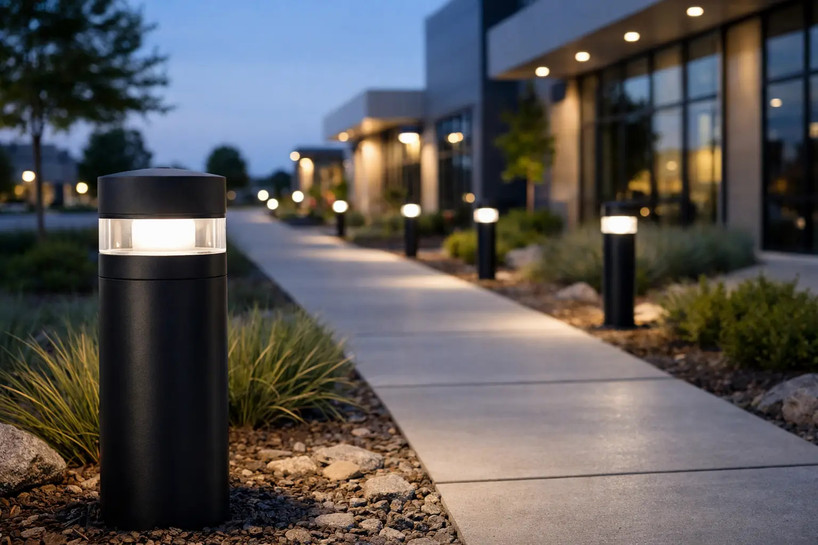
A dark pedestrian route is a safety issue long before it becomes a maintenance complaint. LED pathway bollard lights put usable light at walking level, define where people should travel, and help commercial sites create a more secure appearance without relying on high-mounted area lights alone. For property managers, contractors, and facility teams, the right bollard is less about decorative landscape lighting and more about photometrics, durability, spacing, and long-term serviceability.
What LED Pathway Bollard Lights Do Best
Bollards are short, vertical fixtures installed along sidewalks, building approaches, courtyard paths, plazas, parking-lot pedestrian routes, and landscaped common areas. Their primary job is to provide low-level guidance and reveal walking hazards such as grade changes, curbs, steps, and surface transitions.
Unlike pole-mounted area fixtures, bollards distribute light close to the path. This can improve visual comfort around building entrances and outdoor amenity areas while reducing the harsh contrast created when a bright overhead fixture sits next to an unlit walkway. They also establish a physical visual boundary between pedestrian zones and adjacent vehicle traffic.
The application determines whether a bollard is the right primary light source. A narrow sidewalk through a multifamily property may be well served by spaced bollards and entry lighting. A long route beside an active parking field may need bollards for pedestrian guidance plus area lights for broader site illumination and security coverage. Do not expect a decorative, low-lumen bollard to replace a parking-lot fixture.
Start With the Required Light Level, Not Fixture Wattage
Wattage is useful for estimating energy use, but it does not tell you how the path will look after installation. Evaluate lumen output, distribution pattern, mounting height, spacing, and the surrounding ambient light together.
For a typical commercial walkway, the goal is consistent illumination across the walking surface rather than a series of bright circles with dark gaps between them. A bollard with a shielded or louvered distribution can reduce glare, while an open-top or broad distribution may provide more spread. Neither is automatically better. The right choice depends on fixture placement, nearby windows, landscaping, and whether the site has light-trespass restrictions.
Review photometric data whenever it is available. The fixture's lumen rating describes total output, but the photometric report shows where that light lands. For pathway work, look at maintained foot-candle readings along the centerline and edges of the route. Pay close attention to minimum readings, not just the average. A high average can hide poorly lit areas that create trip hazards or make users feel unsafe.
Fixture spacing should come from the selected bollard's distribution, not a fixed rule such as one fixture every 10 feet. Spacing changes with bollard height, output, path width, mounting location, and reflectance of the pavement. A 42-inch bollard with a wide distribution may cover more ground than a shorter unit, but greater height can also increase visible brightness at eye level. For a large installation, a lighting layout is worth the extra planning time.
Choose Output for the Site Condition
Lower-output bollards can work well for internal garden paths, quiet courtyards, and routes with nearby building lighting. Higher-output commercial models are more appropriate for public walkways, transit-adjacent areas, medical campuses, multifamily access routes, and exposed paths where surrounding light is limited.
More output is not always safer. Excessively bright bollards can cause glare, wash out nearby landscape features, and make the unlit space beyond the fixture appear darker. The practical target is even, usable light that supports wayfinding and pedestrian visibility.
Select Color Temperature and Optics for the Property
Most commercial LED pathway bollard lights are available in 3000K, 4000K, or 5000K options, with some models offering selectable color temperature. The selection affects both appearance and perceived visibility.
A 3000K color temperature provides a warmer appearance that often suits hospitality, residential-style multifamily sites, courtyards, and landscaped entries. It can be a good fit where the property wants a softer nighttime character. A 4000K fixture is a common middle ground for offices, schools, healthcare campuses, retail centers, and general commercial grounds. It provides a neutral white light that supports clear wayfinding without the cooler appearance of 5000K.
A 5000K option may be appropriate for utility paths, industrial facilities, service corridors, and sites that prioritize a brighter visual impression. Before specifying it, check local ordinances, owner preferences, and neighboring-property conditions. Some municipalities and campus standards limit color temperature or require light-control measures near residential areas.
Optics deserve the same attention. Full-cutoff, louvered, shielded, and directional designs manage glare differently. A fixture that sends light outward in all directions may work on a wide plaza but can waste light along a narrow sidewalk. For a path beside a building, a directional distribution can keep more light on the walking surface and less on the façade or windows.
Specify a Bollard Built for Outdoor Service
Commercial bollards face weather, irrigation spray, fertilizer, impact exposure, and frequent temperature swings. A low initial price can become expensive if the finish deteriorates, the lens discolors, or the fixture cannot be serviced without replacing the full unit.
Start with the housing and finish. Die-cast aluminum and heavy-duty aluminum construction are common choices because they resist corrosion while remaining practical to install. Powder-coated finishes provide useful protection, but the environment matters. Coastal properties, areas using de-icing chemicals, and sites with aggressive irrigation conditions may require higher corrosion resistance than a standard inland installation.
Check the ingress protection rating and wet-location listing. An outdoor bollard should be listed for the environment in which it will operate, and its driver compartment, optical chamber, and wire-entry points should be designed to keep out moisture and contaminants. For public-facing locations, review impact resistance as well. Bollards near loading areas, vehicle lanes, or active recreation zones may need separate physical protection from vehicle strikes.
Serviceability is another purchasing factor. Integrated LED bollards can deliver long operating life and reduced maintenance, but product designs vary. Confirm the driver warranty, expected LED life, availability of replacement drivers or light engines, and access method for field maintenance. A fixture with a failed driver should not force an unnecessary site-wide replacement decision.
Plan the Electrical and Mounting Details Early
Most commercial bollards mount to a concrete foundation using an anchor-bolt pattern, base plate, and internal wiring compartment. Confirm the base dimensions and bolt circle before foundations are poured. This is especially important on replacement projects, where existing anchor patterns may not match the new fixture.
Verify voltage before ordering. Many commercial LED bollards operate on 120-277V, which supports common commercial branch circuits. Other projects may require 347-480V equipment, low-voltage landscape systems, or a specific driver configuration. Never assume voltage compatibility from fixture appearance.
Consider controls at the same time. Photocells, time clocks, building automation systems, occupancy sensors, and networked controls can reduce operating hours, but control selection must fit the site. A path used intermittently may benefit from dimming or occupancy-based control if code requirements and safety expectations allow it. A high-traffic public access route often needs consistent dusk-to-dawn operation instead.
Emergency egress is a separate concern. Standard bollards generally do not replace required emergency lighting. If a pathway forms part of the means of egress, verify local code requirements and coordinate bollard lighting with listed emergency fixtures, emergency power equipment, or battery-backup solutions.
Avoid Common Specification Mistakes
The most frequent error is choosing by style and wattage alone. A bollard can look appropriate in a product image yet produce the wrong distribution for the path. Another common problem is mixing color temperatures across an exterior site, particularly when new bollards are installed beside older wall packs or area fixtures.
Avoid placing bollards where doors, gate swings, snow removal, carts, or maintenance equipment will strike them. Keep fixtures clear of accessible travel paths and coordinate locations with landscaping so mature shrubs do not block the light. For routes near parking stalls, set bollards back far enough to reduce vehicle contact and protect them where traffic exposure cannot be avoided.
For projects with multiple paths, entrances, and fixture types, standardizing on a compatible commercial family can simplify ordering, installation, finish matching, and future maintenance. Last Stop Lighting can help buyers compare commercial bollard options by output, voltage, color temperature, construction, and application requirements before the order is placed.
Before releasing a bollard order, walk the route after dark if possible. The site visit often identifies the details a plan misses: a hidden step, a glare-sensitive window, a delivery route, or a section of sidewalk where a better optic will matter more than additional wattage.